
Top 12 Best App Store Optimization Tools for 2025
In the crowded app marketplace, simply having a great app isn't enough; visibility is everything. Effective App Store Optimization (ASO) is the engine that drives organic discovery, connecting your creation with the users who need it most. But the ASO landscape is complex, requiring a strategic blend of keyword intelligence, creative testing, and deep competitive analysis. Trying to navigate it without the right support is like sailing without a compass. This guide is your definitive map to the best app store optimization tools available today.
We cut through the noise to provide a comprehensive resource for indie developers, growth marketers, and even investors. Forget generic feature lists. Inside, you'll find a curated breakdown of 12 powerful platforms, from all-in-one intelligence suites like Sensor Tower to specialized A/B testing tools like SplitMetrics.
Each entry is designed for action, featuring:
- Practical use cases for teams of all sizes.
- An honest assessment of pros, cons, and limitations.
- Clear pricing tier information to match your budget.
- Screenshots and direct links to get you started faster.
We'll even explore how to combine outputs from these tools with your app’s verified revenue data for powerful benchmarking. Whether you're a founder trying to validate traction or a product manager researching competitors, this list will help you find the perfect ASO toolkit. Get ready to transform your app store presence from invisible to inspirational.
1. AppTweak
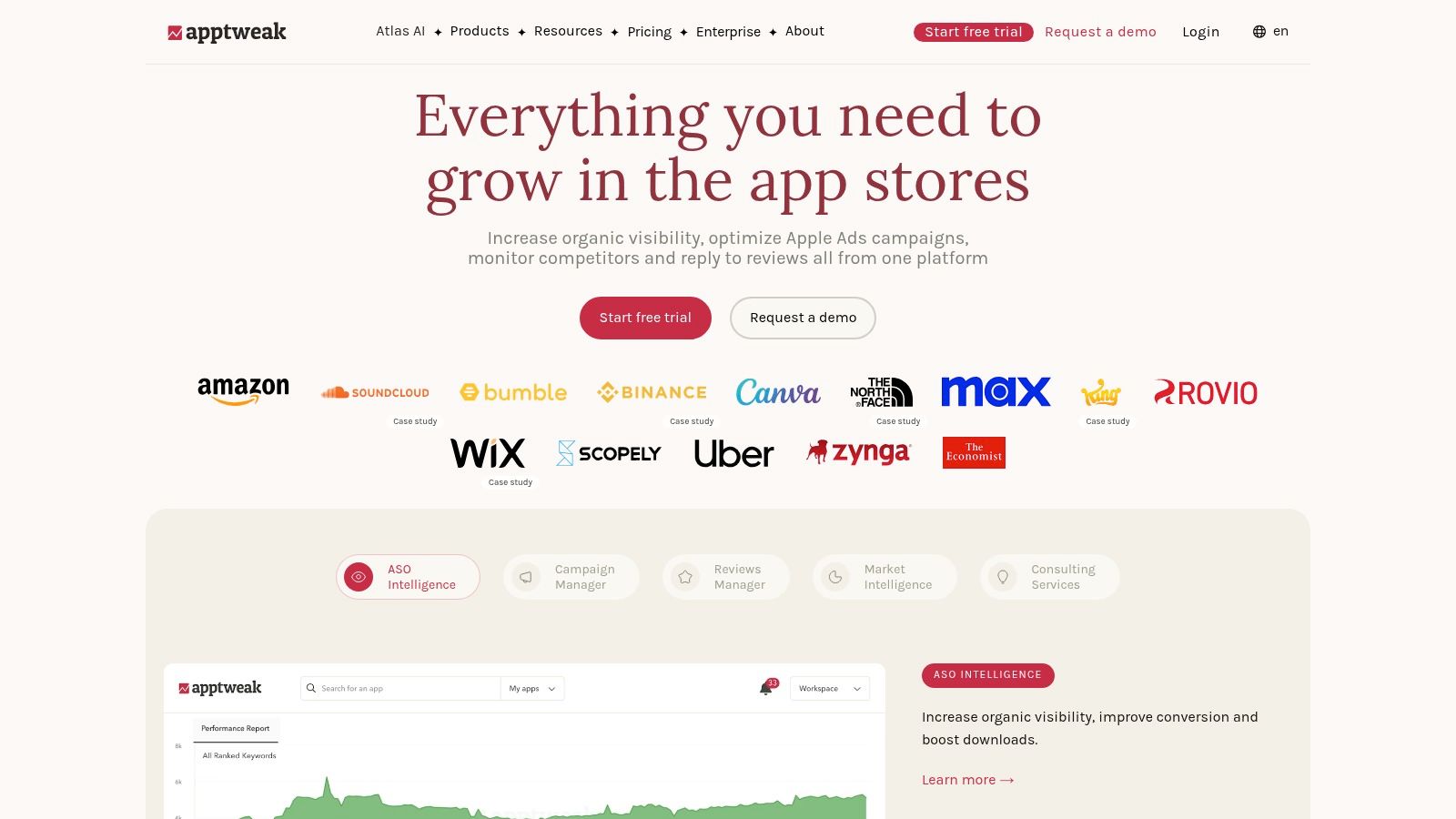
AppTweak stands out as a premier all-in-one ASO platform, transforming the often-siloed disciplines of organic optimization and paid user acquisition into a cohesive, data-driven workflow. It empowers app creators to move beyond guesswork, providing a unified command center for everything from keyword intelligence to creative asset analysis. The platform’s intuitive interface and robust educational resources, including a full certification program, make it one of the best app store optimization tools for teams of all sizes looking to build a sustainable growth engine.
Its key distinction lies in the seamless integration between its ASO suite and its Apple Search Ads Campaign Manager. This allows you to discover high-performing organic keywords and immediately leverage them in your paid campaigns, creating a powerful feedback loop that maximizes visibility and return on investment.
Key Features & Use Case
- Unified ASO & Apple Ads: Discover a keyword organically, track its rank, and instantly add it to a Search Ads campaign within the same dashboard. This synergy is perfect for growth marketers aiming to optimize their entire acquisition funnel, not just individual channels.
- Creative Intelligence: Analyze competitors’ screenshots, icons, and even Custom Product Pages (CPPs). This is invaluable for product managers and designers preparing for a visual refresh or A/B test, providing concrete data on what resonates with users in your category.
- Transparent Pricing: AppTweak offers clear, self-serve pricing tiers with a free trial, eliminating the lengthy sales process common with other enterprise-grade tools.
Practical Considerations
AppTweak’s plans start with an accessible "Starter" tier and scale up to enterprise solutions. While the platform is feature-rich, be aware that some of the most advanced market intelligence modules and API access are add-ons. The lower-tier plans also have per-seat limits, so larger teams will need to factor that into their budget.
However, for developers and marketers who want to understand the complete financial picture of an app's success, pairing ASO data with verified revenue is critical. By analyzing an app's performance metrics alongside its actual earnings, as seen in marketplaces showcasing apps for sale with verified revenue, you gain a powerful benchmark for your own growth potential. This combined insight helps validate whether your ASO strategy is truly driving bottom-line results.
Website: https://www.apptweak.com
2. Sensor Tower
Sensor Tower is an enterprise-grade powerhouse in the app intelligence space, providing a macro-level view of the entire mobile ecosystem. While it offers robust ASO features, its core strength lies in delivering analyst-grade market data on downloads, revenue, and user engagement. This makes it an indispensable tool for large organizations and investors who need to make strategic decisions based on comprehensive market trends and deep competitive benchmarking.
The platform excels at connecting the dots between an app's store presence, its advertising strategy, and its overall market performance. It moves beyond standard ASO metrics to answer bigger questions about market share, audience demographics, and advertising spend, positioning itself as a strategic command center for enterprise-level growth teams.
Key Features & Use Case
- Market Intelligence Dashboards: Gain a high-level overview of market trends, top-performing apps, and publisher leaderboards. This is perfect for strategists and M&A teams identifying market opportunities or evaluating potential acquisition targets.
- App, Ad & Store Intelligence: Uncover a competitor's estimated download and revenue figures, analyze their ad creatives across different networks, and deconstruct their ASO strategy. This holistic view is invaluable for product managers and marketers aiming to outperform established players.
- Enterprise-Grade Reporting: Access vast, exportable datasets and sophisticated reporting tools designed for deep analysis. Data analysts can leverage this to build custom models and forecasts for internal stakeholders.
Practical Considerations
Sensor Tower’s services are primarily geared towards the enterprise market, with pricing available only by quote. This model makes it less accessible for indie developers or small studios. Furthermore, some core ASO workflow functionalities may require subscribing to higher-tier intelligence modules.
However, the high-level data Sensor Tower provides is most powerful when contextualized. By comparing its market estimates with the ground-truth financials of apps listed on marketplaces like those featuring apps for sale with verified revenue, analysts can calibrate their models. This approach allows you to validate market-level data against real-world performance, creating a more accurate and reliable foundation for strategic planning and investment.
Website: https://sensortower.com
3. data.ai
data.ai, the platform formerly known as App Annie, has long been a titan in mobile market intelligence, offering an enterprise-grade view of the entire app ecosystem. While not a pure-play ASO tool, it provides the high-level market context and competitive intelligence that inform a winning ASO strategy. Its strength lies in its vast historical data and sophisticated taxonomy, allowing teams to size up markets, understand category leaders, and identify macro trends before diving into granular keyword optimization.
Its core differentiator is the powerful App IQ feature, which breaks down broad app store categories into hundreds of specific genres and subgenres. This granular classification helps product and marketing teams truly understand their niche, benchmark against direct competitors, and uncover expansion opportunities. This makes it one of the best app store optimization tools for strategic planning and market validation.
Key Features & Use Case
- App IQ Taxonomy: Move beyond the App Store’s generic categories to analyze performance in hyper-specific subgenres like "Hypercasual-Simulation" or "Fintech-Neobank." This is ideal for product managers validating a new app concept or identifying underserved niches.
- Competitive Benchmarking: Analyze top-performing apps with detailed download, usage, and engagement estimates. Growth teams can use this to set realistic performance targets and deconstruct the strategies of market leaders.
- Keyword & Category Insights: While primarily a market intelligence tool, data.ai provides valuable insights into which keywords drive downloads for competitors and how category rankings have shifted over time, fueling initial ASO research.
Practical Considerations
data.ai is squarely aimed at the enterprise market, with pricing available only upon request and typically representing a significant investment. Its acquisition by Sensor Tower also means it is now part of a larger, consolidated ecosystem. The platform's true power is unlocked when its market-level data is used for strategic decision-making, rather than day-to-day ASO task management.
For founders and investors, this high-level intelligence provides a crucial macro view. By comparing data.ai's market-share estimates with the hard numbers found in listings of apps for sale with verified revenue, you can gauge an app's true position and efficiency within its niche, adding a layer of validation to any acquisition or growth strategy.
Website: https://www.data.ai
4. AppFollow
AppFollow carves out a unique niche by deeply integrating App Store Optimization with comprehensive review and reputation management. It acts as a central hub where marketing, support, and product teams can converge, transforming user feedback from a reactive chore into a proactive growth strategy. The platform excels at bridging the gap between how users discover an app (ASO) and how they feel about it post-install (reviews), making it one of the best app store optimization tools for customer-centric brands.
Its standout capability is turning qualitative feedback into quantitative action. By funneling reviews from both app stores directly into workflows like Slack, Zendesk, or Helpshift, AppFollow ensures that critical user sentiment is never missed. This creates a powerful loop where product improvements are driven by real user feedback, which in turn boosts ratings and positively influences ASO performance.
Key Features & Use Case
- Integrated Review Management: Automatically tag, analyze, and reply to reviews from a single dashboard or directly within integrated tools like Slack and Zendesk. This is ideal for support teams looking to streamline their response workflow and improve their app’s overall rating.
- Conversion & Category Benchmarks: Track how your app’s conversion rates from impression to install compare against category averages. Product managers can use this data to identify performance gaps and set realistic goals for A/B testing and metadata updates.
- Organic Traffic & Ads Dashboard: Get a holistic view of your visibility by combining keyword rankings, Search Ads data, and organic traffic estimates. This empowers marketers to see how paid and organic efforts influence each other and allocate budget more effectively.
Practical Considerations
AppFollow offers a generous free plan that is perfect for indie developers or those just beginning their ASO journey. Paid plans scale with features and the number of integrations, keywords, and apps you need to track. While the user interface is powerful, its depth can present a learning curve for newcomers who might initially find the sheer volume of data and settings overwhelming.
For teams aiming to connect their ASO performance with tangible business outcomes, this data becomes even more valuable when cross-referenced with real-world financial metrics. By analyzing the strategies of apps showcased on marketplaces featuring apps for sale with verified revenue, you can establish powerful benchmarks. This insight helps determine if your review management and ASO efforts are translating into the kind of revenue growth that attracts buyers and investors.
Website: https://appfollow.io
5. App Radar
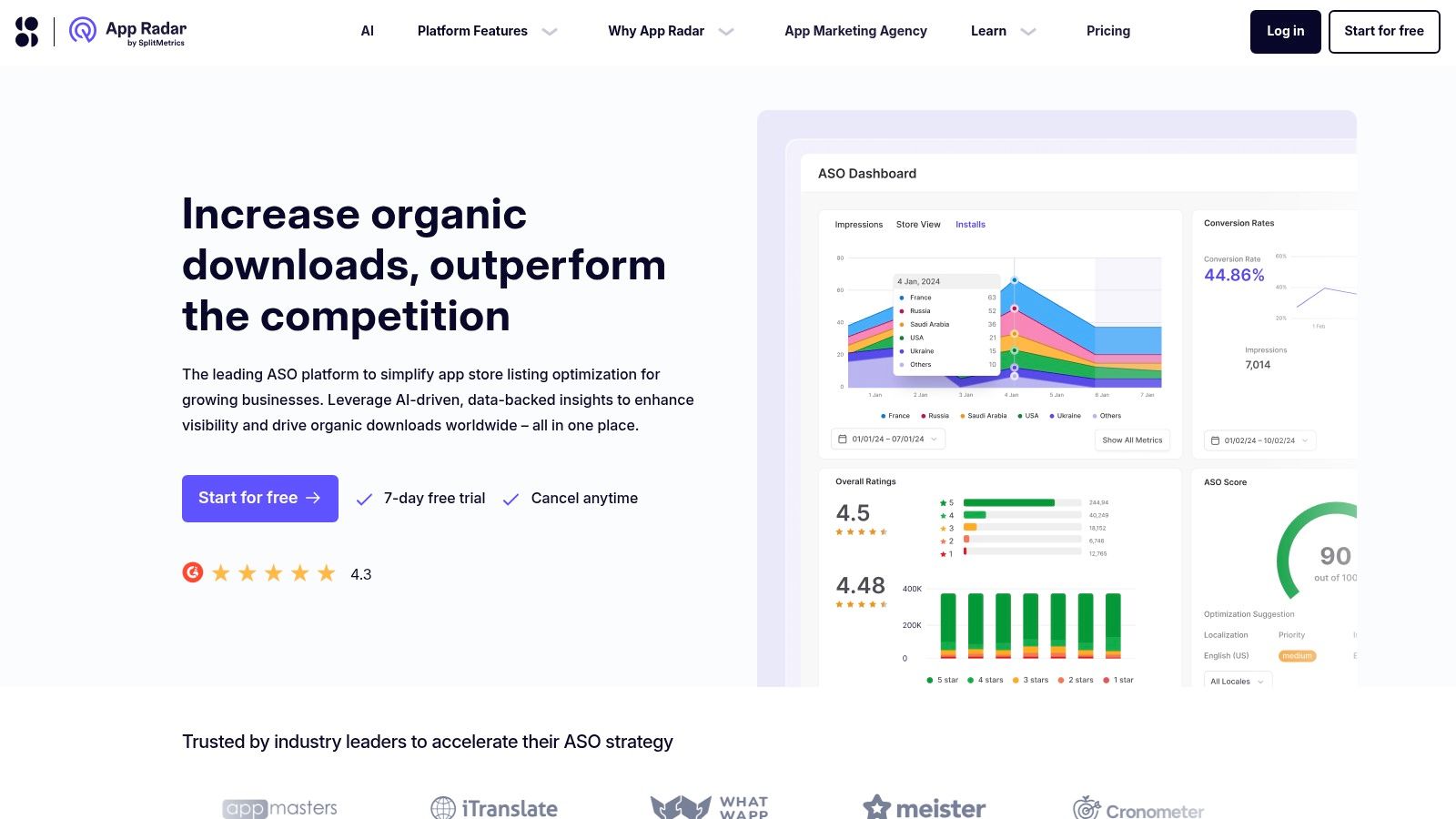
App Radar positions itself as a practical and accessible ASO management platform, designed to simplify the daily workflows of app marketers and small to medium-sized teams. It bridges the gap between complex data analysis and actionable store listing updates, offering a streamlined interface where you can research keywords, edit metadata, and publish changes directly to the app stores. This hands-on approach makes it one of the best app store optimization tools for teams that prioritize efficiency and collaboration over sprawling market intelligence.
Its key differentiator is the focus on tangible listing management and team-based workflows. Rather than just providing data, App Radar gives you the tools to immediately act on it, track version history, and manage localization efforts across multiple languages, all from a single, intuitive hub.
Key Features & Use Case
- Direct Store Listing Management: Edit and push metadata updates for your app store listings directly from the platform. This is a game-changer for marketing managers who need to quickly iterate on text and visuals without going through a full development release cycle.
- AI-Powered Review Management: Leverage AI to summarize user feedback and even generate reply templates. This feature is invaluable for community managers or support teams looking to improve response times and sentiment scores efficiently.
- Transparent & Accessible Pricing: With a clear 7-day free trial and straightforward pricing tiers, App Radar is built for teams that need to get started quickly without a lengthy sales process, making it ideal for SMBs and growing studios.
Practical Considerations
App Radar’s strength is its operational efficiency, but it offers less in-depth market-wide intelligence compared to enterprise-focused platforms. Advanced features like AI-driven reply suggestions and higher tracking limits are reserved for the mid-to-high-tier plans. Teams will need to evaluate if the streamlined workflow benefits outweigh the need for broader competitive landscape data.
However, a focused ASO strategy on a platform like App Radar can drive significant organic growth. To quantify this success, you can benchmark your app's performance against similar apps in your niche. Analyzing marketplaces that feature apps for sale with verified revenue provides a clear financial baseline, helping you connect your optimization efforts to tangible revenue outcomes and set realistic growth targets.
Website: https://appradar.com
6. Appfigures
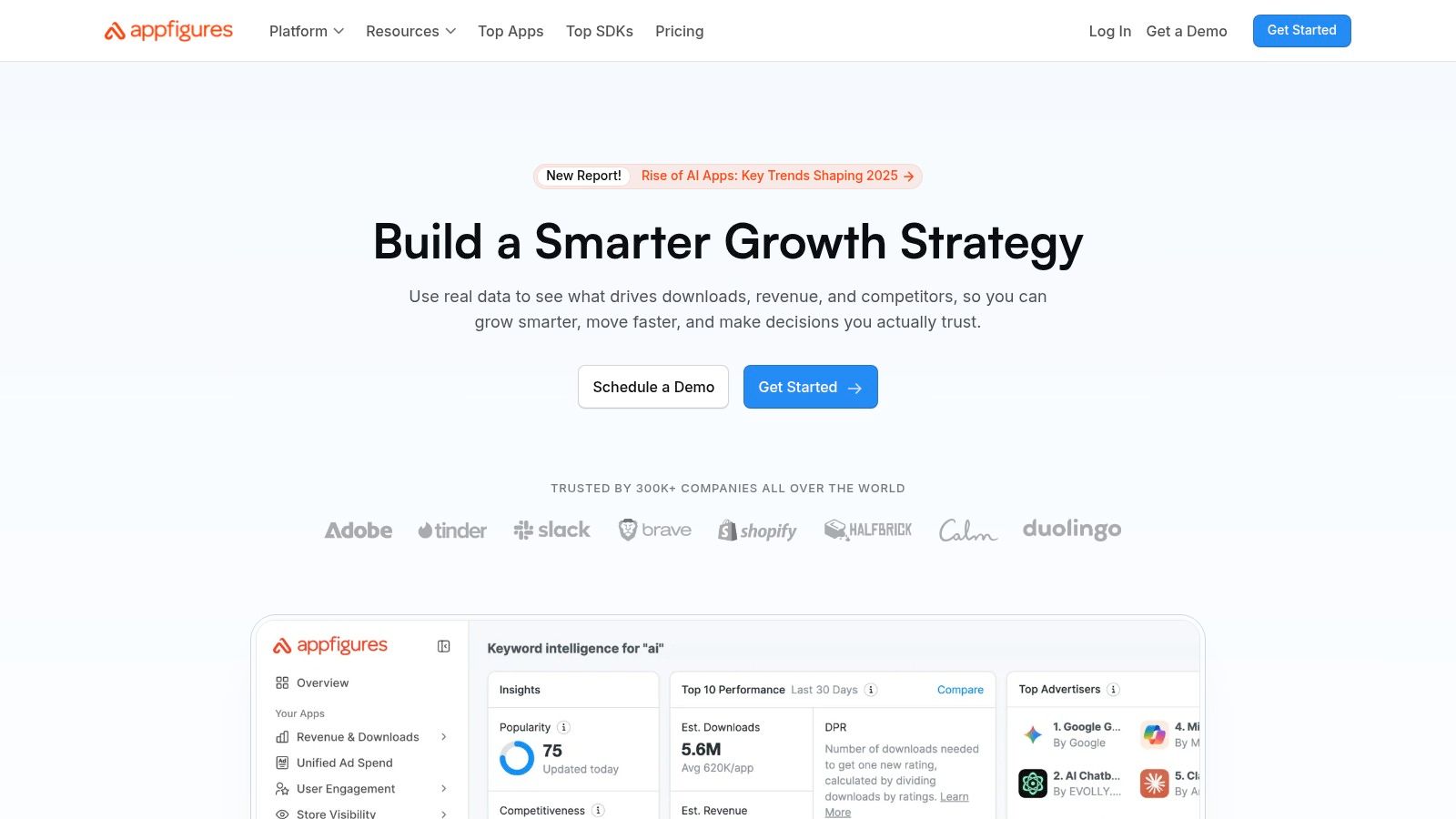
Appfigures shines as a powerful, analytics-first platform that seamlessly integrates ASO with crucial business metrics. It’s designed for the data-driven developer who wants to connect the dots between keyword rankings, app updates, competitor performance, and bottom-line revenue. By providing a comprehensive suite of ASO tools alongside robust store analytics and market intelligence, it serves as a central hub for understanding exactly what drives app growth.
Its unique strength is its ability to deliver an all-in-one view that’s accessible even to indie developers and small teams. Appfigures makes it possible to track everything from keyword difficulty to download trends and ad revenue within a single, unified interface, making it one of the best app store optimization tools for those who need enterprise-level data without the enterprise-level price tag.
Key Features & Use Case
- Integrated Analytics & ASO: Link your App Store Connect and Google Play Console accounts to see how your keyword optimizations directly impact downloads, revenue, and other KPIs. This is perfect for solo developers or small teams trying to prove the ROI of their ASO efforts.
- Competitor Intelligence: Get detailed download and revenue estimates, track competitor SDK usage, and monitor their feature updates. This is invaluable for product managers and strategists looking to identify market opportunities and benchmark their app’s performance.
- Custom Alerts & Reports: Set up automated alerts for rank changes, new reviews, or competitor updates to stay ahead of the curve without living in the dashboard. This is a game-changer for busy founders who need to focus on development but still keep a pulse on the market.
Practical Considerations
Appfigures offers an attractive "Connect" plan that is free for developers tracking their own apps, with ASO features available on paid tiers starting at an affordable price point. While the entry-level plans are generous, the most powerful market intelligence and highest API limits are reserved for more expensive tiers. The per-app and per-keyword tracking limits on lower plans mean you need to choose your targets wisely.
However, this focus on connecting ASO to real-world performance is critical. By analyzing your competitors' estimated earnings on Appfigures and comparing them to publicly available data from platforms like whatsthe.app's marketplace of apps for sale, you can calibrate your expectations and set realistic revenue goals based on what similar apps are actually worth.
Website: https://appfigures.com
7. SplitMetrics Optimize
SplitMetrics Optimize carves out a unique and critical niche within the ASO landscape by focusing exclusively on creative asset validation before you ship. Instead of relying solely on native store experiments, it provides a powerful sandbox environment where you can A/B test your icon, screenshots, video previews, and descriptions on hyper-realistic App Store and Google Play product page replicas. This allows you to de-risk major creative changes and understand user behavior with a level of depth that native tools simply can't offer.
Its core differentiator is the ability to run pre-launch experiments and gather rich behavioral analytics. While a native A/B test tells you which variant won, SplitMetrics Optimize tells you why it won by tracking over 50 metrics like scroll depth, time on page, and engagement with specific gallery assets. This makes it one of the best app store optimization tools for product marketers and design teams aiming to perfect their visual storefront and maximize conversion rates with confidence.
Key Features & Use Case
- Pre-Launch Validation: Test your entire product page concept on target audiences before your app is even live. This is ideal for founders and studios looking to validate their market positioning and messaging from day one, ensuring a stronger launch.
- Deep Behavioral Analytics: Go beyond simple conversion numbers. See exactly how users interact with your creative assets, identifying which screenshots they linger on or if your video holds their attention. This is invaluable for creative teams needing to iterate based on detailed user feedback.
- Multi-Variant Testing: Run experiments with multiple variations of icons, screenshots, and videos simultaneously to find the optimal combination, accelerating your creative optimization cycle.
Practical Considerations
SplitMetrics Optimize operates on a custom pricing model, typically requiring a consultation to tailor a plan to your needs. A key factor to budget for is the additional media spend required to drive traffic to your experiment pages. While it provides unparalleled insights, it is an additional step outside the native app store consoles.
For a holistic view, comparing your refined creative conversion rates against real-world financial outcomes is the ultimate goal. Analyzing top-performing apps with transparent financials, such as those found in marketplaces listing apps for sale with verified revenue, provides a crucial benchmark. It helps you connect the dots between a high-converting product page and the sustainable revenue it can generate.
Website: https://splitmetrics.com/optimize
8. Storemaven
Storemaven positions itself as a creative optimization powerhouse, moving beyond simple keyword tools to focus on the most impactful part of the app store: the product page itself. It provides a sophisticated A/B testing platform that allows developers to test icons, screenshots, and videos in a simulated store environment, gathering deep behavioral analytics before committing to a live change. This focus on pre-launch validation and creative iteration makes it one of the best app store optimization tools for de-risking major design updates and maximizing conversion rates.
Its core strength is its scientific approach to creative ASO. Storemaven doesn’t just tell you which variant won; it shows you why by analyzing user scroll depth, video watch time, and engagement patterns. This empowers teams to build a data-backed creative strategy that resonates deeply with their target audience.

Key Features & Use Case
- Product Page A/B Testing: Create look-alike iOS and Google Play store pages to test creative hypotheses on real users. This is essential for user acquisition managers looking to optimize their paid funnels and ensure ad spend isn't wasted on a low-converting product page.
- Behavioral Analytics: Gain insights into how users interact with your test pages, including scroll rates and engagement with specific assets. Product managers can use this data to inform not just ASO, but the entire product design and feature prioritization roadmap.
- Expert Strategic Support: Storemaven offers access to ASO experts and playbooks, providing strategic guidance beyond just the software. This is invaluable for teams new to creative testing who want to avoid common pitfalls.
Practical Considerations
Storemaven does not offer public pricing and is geared toward mid-to-enterprise-level budgets, often requiring a custom quote. A key factor to consider is that you must drive your own traffic to the test pages, typically through paid ad campaigns, to achieve statistically significant results. This means factoring in an additional media budget alongside the platform cost.
However, understanding the conversion potential of your creatives is only half the story. To truly gauge success, you must compare your potential earnings against real-world benchmarks. Analyzing apps for sale with verified revenue provides a tangible financial baseline, helping you set realistic goals for what a highly optimized product page can achieve in your specific category.
Website: https://www.storemaven.com
9. Apple App Store Connect (Product Page Optimization)
While many tools offer simulated A/B testing, Apple’s native Product Page Optimization (PPO) goes straight to the source. Integrated directly within App Store Connect, this feature is less of an all-in-one platform and more of a powerful, focused instrument for validating your creative assets. It allows developers to test different app icons, screenshots, and app preview videos on real, live App Store traffic, removing all guesswork and third-party discrepancies from the equation.
Its core value is its authenticity. Instead of relying on ad-based landing pages to predict conversion, you’re running tests within the actual App Store environment where users make their final download decisions. This makes it an indispensable tool for any serious iOS developer looking to optimize their product page’s conversion rate with the highest possible data integrity, solidifying its place among the best app store optimization tools.
Key Features & Use Case
- Native A/B Testing: Test up to three alternative "treatments" against your default product page. This is perfect for marketers wanting to confirm with certainty which new icon or screenshot set drives the highest tap-to-install conversion rate before committing to a full rollout.
- Bayesian Statistics: Results are presented with a clear confidence level, helping you make statistically sound decisions. This is ideal for data analysts and product managers who need to justify creative changes with concrete performance metrics.
- Direct Implementation: Apply a winning treatment to your live App Store page with a single click, directly from the App Analytics dashboard, streamlining the optimization workflow.
Practical Considerations
PPO is free for all members of the Apple Developer Program, making it incredibly accessible. However, its scope is limited to visual assets on the iOS App Store; it doesn't offer keyword or metadata testing. Tests can run for up to 90 days, but your app must be in a "Ready for Sale" state to start one, and icon tests require a new app binary to be submitted for review. This requires more planning compared to third-party tools.
Understanding the official platform is crucial for success. By studying the guidelines, you can ensure your tests are effective and compliant. For a detailed walkthrough on setting up and interpreting these native tests, you can get more information by learning more about the essentials of Apple Store Connect Product Page Optimization. This knowledge helps you leverage the tool to its full potential, directly impacting your app's growth.
Website: https://appstoreconnect.apple.com
10. Google Play Console (Store Listing Experiments)
While many tools offer creative testing simulations, Google Play Console's native Store Listing Experiments provide the ultimate source of truth for Android developers. This built-in feature allows you to A/B test your app's icon, screenshots, video, and text descriptions directly on live Play Store traffic. It's an indispensable tool for data-driven creative optimization, removing all guesswork by measuring how real users respond to your assets.
Its key distinction is the authenticity of the data. Instead of relying on panel-based or simulated environments, experiments are run with your actual target audience within the Google Play ecosystem. This provides unparalleled confidence that your winning variant will genuinely drive more installs, making it one of the best app store optimization tools for any serious Android developer.
Key Features & Use Case
- Live Traffic A/B Testing: Test different icons, feature graphics, or short descriptions on segments of your actual store visitors. This is perfect for product marketers looking to validate a creative rebrand or a new value proposition with concrete performance data before a full rollout.
- Localized Experiments: Run tests targeted at specific countries and languages. This empowers international growth teams to tailor their creative assets to cultural nuances, ensuring the store listing resonates effectively in each unique market.
- Acquisition & Retention Metrics: The console reports not only on first-time installers but also on retained installers for each variant. This crucial data helps you identify creative that attracts high-quality, long-term users, not just fleeting downloads.
Practical Considerations
The primary advantage of Store Listing Experiments is that it's free for any registered Google Play developer (a one-time $25 registration fee is required). The main limitation is that tests can be slow to reach statistical significance if your app has low store listing traffic. Additionally, the tool is exclusive to the Google Play Store and cannot be used for iOS assets.
For developers seeking to master this platform, understanding the full scope of its capabilities is essential. You can learn more about maximizing your app's potential through the official Google Play Console documentation, which provides a foundation for running effective experiments and interpreting their results to drive sustainable growth.
Website: https://play.google.com/console
11. G2
G2 serves as an indispensable meta-resource for any team evaluating the best app store optimization tools. Instead of being a tool itself, it's a comprehensive B2B software marketplace that aggregates real user reviews, comparisons, and detailed feature ratings. This platform allows you to step back from vendor marketing and see how different ASO solutions perform in the wild, providing critical social proof and crowdsourced wisdom to guide your purchasing decisions.
Its primary value is in validation and discovery. G2’s curated App Store Optimization category provides a living landscape of the available tools, ranked and reviewed by peers. It empowers you to compare platforms feature-by-feature based on user satisfaction ratings, filter solutions by business size, and read detailed pros and cons from people facing the same challenges as you. It's the perfect starting point to create a shortlist and a final checkpoint before committing to a subscription.
Key Features & Use Case
- Peer-Driven Reviews & Ratings: Access thousands of in-depth user reviews that break down the pros and cons of each ASO platform. This is invaluable for a marketing manager tasked with selecting a tool, as it offers unbiased insights that balance out sales pitches.
- Grid Comparison Reports: Use G2’s dynamic comparison grid to see how top tools stack up against each other on key criteria like Keyword Research, Competitor Analysis, and Ease of Use. This helps teams quickly identify which platforms excel in their most-needed areas.
- Buyer Guides & Category Reports: Download reports that summarize the ASO tool landscape, highlighting market leaders, high performers, and emerging contenders. This is ideal for strategy leads who need a high-level overview before diving into individual tool demos.
Practical Considerations
G2 is a free resource for buyers, but it's important to cross-reference the information. Details like pricing and specific feature sets can sometimes lag behind the vendors' official websites. Additionally, some reviews might focus on a tool's general business intelligence features rather than its specific ASO capabilities, so it’s wise to filter for reviews from users with similar roles and goals to your own.
Ultimately, G2 helps you build confidence in your tool selection. By understanding how other companies leverage these platforms, you can better contextualize your own strategy. This is especially true when comparing your ASO performance against the financial realities seen on marketplaces like whatsthe.app, where verified app revenue data can confirm if a competitor’s high-ranking ASO strategy truly translates to profitability.
Website: https://www.g2.com/categories/app-store-optimization
12. ASOdesk
ASOdesk is an analytical powerhouse built for app marketers who need to manage a large portfolio of apps or track a high volume of keywords with precision. It offers a comprehensive suite of ASO tools that excel at automation and deep data analysis, allowing teams to scale their optimization efforts efficiently. The platform is designed to transform raw app store data into actionable insights, helping you pinpoint keyword opportunities and monitor competitor strategies across multiple regions.
Its key distinction is its focus on workflow automation and detailed reporting. ASOdesk allows users to set up custom alerts, generate scheduled reports, and monitor keyword performance with minimal manual intervention. This makes it one of the best app store optimization tools for agencies or large marketing teams juggling numerous ASO projects simultaneously.
Key Features & Use Case
- Advanced Keyword Intelligence: Utilize detailed keyword tables that include Search Ads Popularity, difficulty scores, and historical ranking data. This is ideal for ASO managers conducting in-depth research to find high-impact, low-competition keywords for their next metadata update.
- Automation & Custom Alerts: Set up activity logs and custom alerts for keyword rank changes, competitor updates, or feature graphic changes. This is invaluable for busy teams who need to stay informed of critical market shifts without constantly checking a dashboard.
- Localization Workflows: The platform includes dedicated tools to streamline the process of localizing app store listings, a crucial feature for global app publishers looking to expand their international footprint.
Practical Considerations
ASOdesk offers a flexible but potentially complex pricing matrix, with separate plans for ASO and review management modules. While this allows for customization, new users may find it takes time to identify the right package. The interface is data-dense, which is powerful for experienced users but could present a steep learning curve for beginners. Advanced features and API access are typically reserved for higher-tier plans.
For teams managing a portfolio, comparing the ASO performance data from ASOdesk with real-world financial outcomes is a powerful strategy. By cross-referencing your optimization results with the benchmarks provided by marketplaces listing apps for sale with verified revenue, you can better project the potential ROI of your ASO campaigns and justify investment in scaling your efforts.
Website: https://asodesk.com
Top 12 ASO (App Store Optimization) Tools Comparison
| Tool | Core features ✨ | Quality / UX ★ | Pricing / Value 💰 | Target audience 👥 | Strength / USP 🏆 |
|---|---|---|---|---|---|
| AppTweak | Keyword DB, creative intelligence, Apple Search Ads | ★★★★☆ | 💰💰 (transparent self‑serve) | 👥 ASO teams & Apple Ads users | 🏆 Unified ASO + Apple Ads workflow |
| Sensor Tower | Downloads, revenue, ads, audience, ASO modules | ★★★★★ | 💰💰💰💰 (enterprise) | 👥 Enterprises & analysts | 🏆 Analyst‑grade, global coverage |
| data.ai | App IQ taxonomy, benchmarking, historical data | ★★★★★ | 💰💰💰💰 (enterprise) | 👥 Market researchers & enterprises | 🏆 Deep taxonomy & long history |
| AppFollow | Keyword tracking, reviews, integrations, API | ★★★★☆ | 💰💰 (generous free plan) | 👥 Support & ASO teams | 🏆 Review ops + ASO in one platform |
| App Radar | Keyword tracking, listing edits, localization | ★★★★ | 💰💰 (SMB‑friendly) | 👥 SMBs & listing managers | 🏆 Practical listing management |
| Appfigures | ASO + analytics, revenue/download estimates, alerts | ★★★☆ | 💰 (affordable entry tiers) | 👥 Indies & small teams | 🏆 ASO + store analytics affordability |
| SplitMetrics Optimize | Out‑of‑store A/B, 50+ behavioral metrics | ★★★★☆ | 💰💰💰 (quote; traffic spend) | 👥 UA teams & creatives | 🏆 Rich behavioral insights for creatives |
| Storemaven | Product page A/B, behavioral analytics, strategy | ★★★★☆ | 💰💰💰 (mid→enterprise) | 👥 Mid/enterprise UA & ASO teams | 🏆 Strategic support + in‑depth analytics |
| Apple App Store Connect (PPO) | Native PPO: 3 treatments, localization, Bayesian | ★★★★ | 💰 (free with dev account) | 👥 iOS developers | 🏆 Free native in‑store testing |
| Google Play Console (Experiments) | Store listing A/B, localized metrics, retention | ★★★★ | 💰 (free with dev account) | 👥 Android developers | 🏆 Free native Play experiments |
| G2 | Vendor pages, user reviews, buyer guides | ★★★★ | 💰 (free browsing; lead gen) | 👥 Buyers & shortlisting teams | 🏆 Real user feedback & comparisons |
| ASOdesk | Keyword tables, competitor spy, automation, API | ★★★★ | 💰💰 (configurable plans) | 👥 Teams tracking many keywords/apps | 🏆 Scales for large keyword tracking |
From Data to Dominance: Building Your Winning ASO Strategy
You've just navigated a comprehensive landscape of the best app store optimization tools available today, from all-in-one intelligence platforms like Sensor Tower and data.ai to specialized A/B testing powerhouses like SplitMetrics and Storemaven. The journey from simply having an app to having a thriving, discoverable mobile business is paved with data, and these tools are your vehicle. But a powerful vehicle is only as good as the driver and the map they follow.
The true takeaway isn't that one single tool will magically catapult you to the top of the charts. Instead, the breakthrough comes from understanding that ASO is not a one-time task but a dynamic, iterative cycle of research, implementation, testing, and analysis. Each tool we've explored, whether it’s App Radar for keyword optimization or AppFollow for managing your community's voice, provides a critical piece of this strategic puzzle.
Your Blueprint for ASO Success
The path forward is about building a system, not just buying a subscription. As you decide on your next steps, let this framework guide your thinking:
- Define Your Stage: Are you a solo indie developer on a bootstrapped budget? Your focus might be a nimble combination of a free tool like Appfigures for basic tracking and the native testing platforms on App Store Connect and Google Play Console. Are you a growth-focused studio or an investor evaluating acquisitions? A robust platform like AppTweak or Sensor Tower becomes non-negotiable for deep competitive intelligence.
- Create a "Single Source of Truth": Data from multiple sources can be overwhelming. Choose one primary tool for your core KPIs like keyword rankings and visibility scores. Use others to supplement its weaknesses, such as using G2 for qualitative feedback or ASOdesk for specific regional insights, but always return to your central dashboard to track progress.
- Integrate and Automate: The real power of these tools is unlocked when they talk to each other. Connect your ASO tool to Slack for review alerts. Pipe your keyword ranking changes into your team's project management software. Automating these data flows transforms ASO from a periodic chore into a constant, background process that informs your entire team.
Grounding Estimates in Reality
A crucial theme we've revisited is the difference between estimated data and verified performance. While the best app store optimization tools provide invaluable market intelligence and download estimates, these are sophisticated projections, not bank statements. To truly benchmark your app's performance and set achievable goals, you must anchor these insights in reality.
This is where the strategy evolves from good to great. By cross-referencing the competitive keyword opportunities and market-size estimates from your ASO tool with verified, real-time revenue data, you gain a powerful advantage. This combined view allows you to see not just what your competitors might be earning based on their visibility, but what top apps in your category are actually generating. This crucial step calibrates your expectations, validates your monetization strategy, and provides concrete targets for your growth efforts.
You are now equipped with more than just a list; you have a strategic guide. The journey to app store dominance is a marathon, not a sprint, fueled by relentless testing and data-driven curiosity. Select your toolkit, commit to the process, and begin the inspiring work of turning raw data into measurable, undeniable growth. Your app's potential is waiting to be unlocked.
Ready to bridge the gap between market estimates and financial reality? While ASO tools estimate performance, what's the app provides the verified revenue and user data you need to benchmark with confidence. Supercharge your competitive research by connecting the insights from your favorite tools to the ground truth of the market at what's the app.
Related Articles

A Guide to Mobile App Competitive Analysis
Level up your product strategy with our guide to mobile app competitive analysis. Uncover actionable insights and outperform your rivals in the app store.

How Do You Launch an App Built to Sell?
Learn how do you launch an app designed for acquisition. This guide offers proven strategies for building a sellable asset from day one.

What Is the Real Simple App Cost to Buy or Sell an App
Discover the true simple app cost. Our guide reveals the factors that determine app valuation for buyers and sellers, from build costs to revenue potential.

Buying & Selling Mobile Apps: The Definitive Guide for 2024
Thinking about buying mobile apps? Learn how to find, value, and acquire profitable apps with our founder-first guide to due diligence and deal-making.