
A Guide to Mobile App Competitive Analysis
Let's be honest, most competitive analysis for mobile apps is a waste of time. It usually boils down to a glorified feature checklist—a static snapshot that tells you what your rivals are doing, but never why. That's not a strategy; it's just imitation.
True competitive intelligence is about deconstructing their entire business. It’s a deep dive into how they make money, attract users, and keep them coming back. This isn't about copying. It's about uncovering the strategic gaps they've missed, giving you the playbook to build something genuinely different and better.
A Mindset Shift: From Copycat to Category Leader
Think of this guide as your blueprint for turning a tedious chore into your most powerful weapon for growth. We're going to move beyond surface-level comparisons and dig into the mechanics that actually drive success in this ridiculously crowded market. This is how you stop reacting and start making confident, proactive decisions that steal market share.
The goal here is simple: find inspiration for real innovation, not just imitation. When you understand the whole picture, you can finally:
- Spot the Gaps: Pinpoint underserved user needs or pricing models that everyone else is overlooking.
- Build with Confidence: Use hard data from the market to validate your product roadmap and ensure you’re solving real problems.
- De-Risk Your Big Bets: Whether you're launching a new feature or expanding into a new market, solid intelligence takes the guesswork out of the equation.
This shift isn't just a nice-to-have; it's a survival tactic. The mobile app market is exploding, with projections estimating its global size to land somewhere between $330 billion and $585 billion by next year. And with nearly 299 billion downloads happening annually, just being "good enough" won't cut it. You can explore more of these eye-opening mobile app market statistics on dojobusiness.com.
The real objective of competitive analysis is not to create a mirror image of your competitors, but to find the empty spaces on the canvas where you can paint your masterpiece. It’s about seeing what they don’t see and building what they haven’t built.
Ultimately, what we're building here is an ongoing intelligence system—a constant pulse on the market that becomes the backbone of your strategy. By understanding your competitors on a profoundly deeper level, you gain the clarity to not just compete, but to lead. This is how you build a resilient, forward-thinking app that thrives, no matter what the market throws at it.
Building Your Competitive Intelligence Blueprint
A powerful competitive analysis doesn't start with spreadsheets. It starts with a question. Before you dive into a sea of data, you have to know what you're looking for. Without a clear mission, you're just collecting trivia, not intelligence.
Think of it this way: are you trying to find a crack in a competitor's pricing? Maybe you're hunting for an underserved audience they've completely ignored. Or perhaps the goal is to map out their entire user acquisition playbook to find channels they haven't touched yet.
Defining this focus from the very beginning is what separates a vague research project from a targeted intelligence operation. It’s the difference between wandering and winning.
Define Your Core Objectives
Start by asking the most important question: What single decision will this analysis help me make?
This forces absolute clarity. It stops your work from becoming a purely academic exercise and keeps you focused on what really matters. Your goal isn't just to learn; it's to act.
Here are a few powerful objectives I’ve seen teams rally around:
- Validate the Product Roadmap: Pinpoint feature gaps or glaring areas of user frustration in other apps. This is gold for prioritizing your own development backlog.
- Sharpen Your Pricing Strategy: Dig into competitor subscription tiers, their trial conversion tactics, and any in-app purchases. You're looking for an opportunity to build a more compelling offer.
- Uncover User Acquisition Channels: Reverse-engineer how rivals are getting their downloads. This can reveal untapped marketing channels or messaging angles you can own.
- Carve Out Your Market Position: Truly understand the unique value prop of every major player. This helps you find a distinct and defensible position for your own app in a crowded market.
This simple flow shows how you move from just gathering data to making a real, tangible decision.
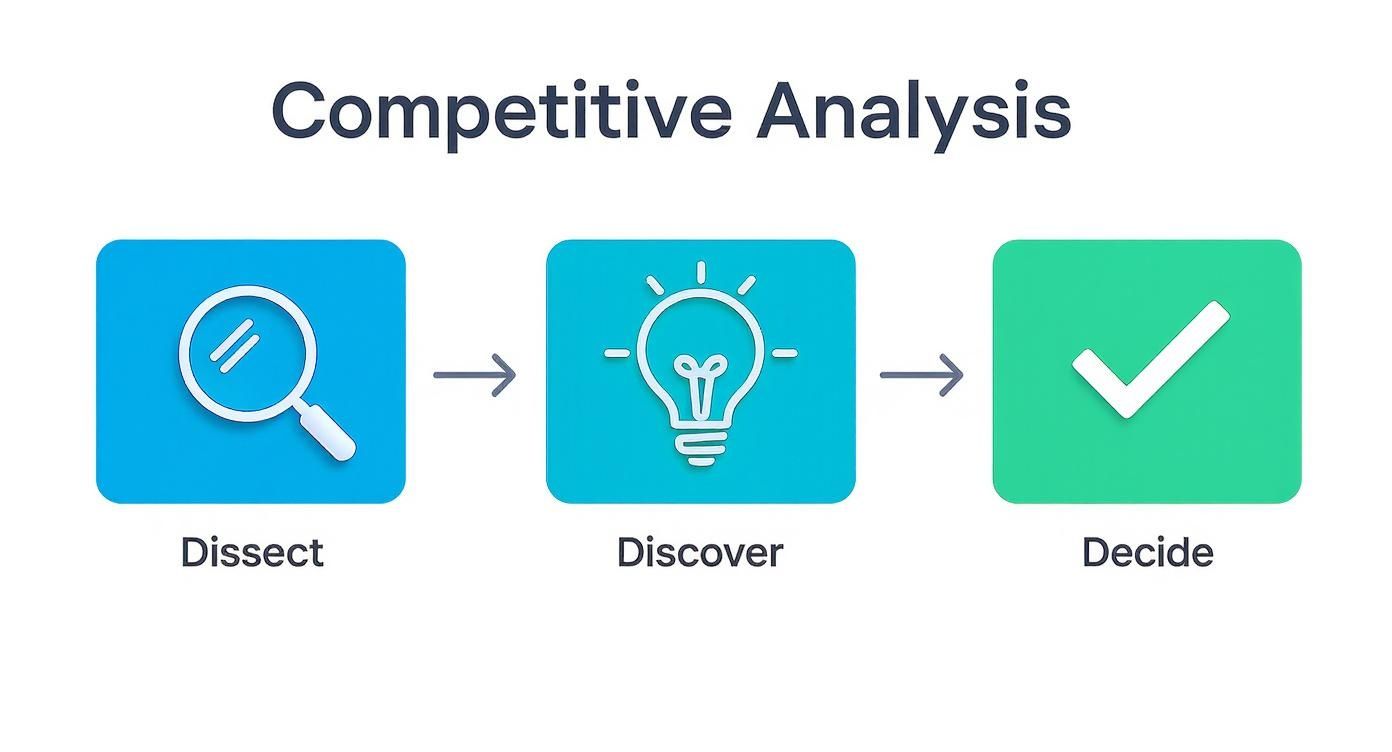
Remember, dissecting the competition is just step one. The real payoff comes when you can make a confident, data-informed move.
Identify Your True Competitors
With your mission locked in, it’s time to pick your targets. This is about more than just listing the obvious names in your category. A truly insightful analysis looks at a wider ecosystem of apps all vying for the same thing: your user's attention and budget.
I like to think about competition in three distinct tiers:
Direct Competitors: These are the apps offering a very similar solution to the same audience. Think Calm vs. Headspace. They are in a head-to-head battle for the same user with a nearly identical promise.
Indirect Competitors: These apps solve the same core problem, but in a totally different way. For Calm, this might be a journaling app like Day One or even a habit tracker. They all compete for a slice of the user's "mental wellness" time, even with completely different features.
Aspirational Competitors: These are best-in-class apps from other categories that have absolutely mastered something you want to improve. Want to nail your onboarding? Study Duolingo. Want to build a fanatical community? Look at what Strava has done.
Don't just analyze the apps you want to beat. Analyze the apps you want to be like. The biggest breakthroughs often come from looking outside your own bubble.
Select the Right Metrics to Track
Now for the final piece of the blueprint: choosing what to measure. This is where so many teams get it wrong. They get lost chasing vanity metrics like all-time downloads, which tell you very little about a business's current health.
Instead, build your framework around a core set of metrics that tell a story.
- Monetization Health: For subscription apps, everything comes down to Monthly Recurring Revenue (MRR) and Average Revenue Per User (ARPU). These are the vital signs.
- Growth Momentum: Forget all-time downloads. You need to track download velocity—the number of new downloads in the last 30 days. This tells you who has momentum right now.
- Engagement Proxies: You can’t see a competitor's active user data, but you can get close. Use app store review volume and velocity as a proxy for engagement. A sudden spike in new reviews is a huge signal that often follows a big feature release or a successful marketing campaign.
Putting this blueprint together first ensures that every data point you collect has a purpose. It gives you the structure to turn raw information into strategic insight, giving you the confidence to make decisions that will actually move the needle.
Where to Find—and Actually Vet—Your Competitive Data

Any sharp analysis is only as good as the data it’s built on. Without reliable intelligence, your brilliant strategy is just a shot in the dark. The real magic happens when you stop looking at data points in isolation and start weaving them together—blending high-level market estimates with the raw, qualitative insights hidden in plain sight.
This is where you build a complete, evidence-based picture of the competitive landscape.
Your journey will almost always start with dedicated app intelligence platforms. Think of tools like Sensor Tower and data.ai as the industry standard, and for good reason. They give you powerful estimates for the big-picture metrics—revenue, downloads, user engagement—that are otherwise completely invisible. These platforms are your eye in the sky, giving you the directional data you need to map out market share and track momentum.
But a word of caution: don't treat these numbers as gospel. They are sophisticated, data-driven estimates. Their true power lies in spotting trends. A sudden surge in a competitor's downloads or a slow, steady bleed in their revenue is a signal. It's the "what" that prompts you to dig deeper and find the "why."
Mining the App Stores for Qualitative Gold
The app stores themselves are a goldmine for competitive intel. While the big platforms give you the numbers, the app store product pages tell you the story. This is where you see exactly how competitors position themselves, what features they scream about, and what promises they’re making to reel in users.
Go deep and deconstruct their entire product page.
- App Title & Subtitle: What keywords are they stuffing in there? What core benefit do they lead with? Is it "AI Photo Editor" or "Create Magical Avatars"?
- Icon & Screenshots: What's the first impression? Are their visuals focused on pure utility, showcasing a killer feature, or are they selling an aspirational lifestyle?
- Description & "What's New": How do they articulate their value prop? Scour their update history in the "What's New" section—it’s a breadcrumb trail of their development velocity and strategic pivots.
This isn't just about creating a feature checklist. It's about reverse-engineering their entire go-to-market strategy right from the source. To get a better handle on how this all fits together, it's worth exploring the data points available directly on the Google Play Store and how they're structured.
Tapping Into the Voice of the Customer
User reviews are the most brutally honest feedback you'll ever find on a competitor's product. This is where you discover the unfiltered truth about infuriating bugs, critical feature gaps, and those rare moments of pure user delight.
Don't just glance at the overall star rating. The real intelligence is buried in the 1-star and 3-star reviews.
These reviews are a roadmap for your next big opportunity. When you see dozens of users begging for the same missing feature or complaining about the same clunky workflow, that’s a flashing neon sign pointing directly at an unmet need you can swoop in and solve.
Your competitor's 1-star reviews are your next feature's user stories. They are a detailed roadmap, handed to you by the very users you want to win, spelling out every frustration you can solve better.
Competitive Data Sourcing Cheat Sheet
Pulling all this information together requires a multi-pronged approach. No single tool gives you the full picture. Here’s a quick-reference guide to help you find the right data from the right sources.
| Data Point | Primary Source (Tool/Platform) | Secondary Source (Verification) | What It Reveals |
|---|---|---|---|
| Revenue & Downloads | Sensor Tower, data.ai | App Store "Top Charts" | Market size, growth trajectory, and monetization efficiency. |
| User Demographics | data.ai, Statista | User Reviews, Social Media Comments | Who the active user base is and their core motivations. |
| Feature Prioritization | App Store "What's New" Section | User Reviews (feature requests) | The competitor's product roadmap and development velocity. |
| Positioning & Messaging | App Store Page (Title, Desc.) | Ad Creatives (Meta Ad Library) | The core value proposition and benefits they're selling. |
| User Pain Points | User Reviews (1-star & 3-star) | Reddit, Twitter, Forums | Unmet needs and clear opportunities for you to win. |
| UA & Creative Strategy | Meta Ad Library, TikTok Ad Library | Social Media Pages | Their go-to-market engine, target audience, and ad spend focus. |
By cross-referencing these sources, you can build a much more robust and reliable picture of what’s actually happening, moving from educated guesses to data-backed assertions.
Reverse-Engineering Their Growth Engine
Finally, to understand how your rivals are actually acquiring all those users, you have to peek behind the curtain of their growth engine. Tools like the Meta Ad Library are fantastic for this. They let you see the exact ad creatives, copy, and calls to action they're using to fuel the fire.
By dissecting their ads, you can quickly deduce:
- Their Target Audience: Who are they talking to? What specific pain points are they agitating in their ad copy?
- Their Core Value Prop: What key benefits are they hammering home in their campaigns? Is it speed, simplicity, or a unique outcome?
- Promotional Hooks: Are they leading with a 7-day free trial, a 50% off launch offer, or another incentive to drive installs?
This intelligence sheds light on their entire go-to-market motion and can help you spot channels or messaging angles they’ve completely missed.
When you combine high-level platform data, deep app store analysis, raw user feedback, and ad intelligence, you graduate from simple observation to true strategic insight. You build a multi-layered, verifiable view of your competitors' world, ensuring your next big move is made with confidence.
Connecting the Dots From Data to Insight

Pulling together all this data is just the beginning of a truly powerful mobile app competitive analysis. The real win—the moment that changes everything—is when you find the story hidden inside the numbers. This is where you shift from being a data librarian to a data detective, piecing together clues to see your competitor's entire playbook.
Raw figures on their own are just noise. It's only when you start layering different data sets that a clear narrative begins to form. You’ll see how a big spike in ad spend connects to a jump in downloads, or how a new feature release lines up perfectly with a change in user review sentiment. This isn't about spreadsheets; it's about synthesis.
Your mission is to build a living, breathing picture of your competitor's business, not just a static snapshot. Let's dig into a few frameworks that will help you turn all that raw data into insights you can actually use.
Mapping Features to True User Value
One of the most common traps I see teams fall into is creating a simple feature checklist. "We have X, they have Y." This approach is a dead end because it completely misses the most important ingredient: user value. A feature is completely worthless if your users don't actually care about it.
Instead of a checklist, I want you to build a Feature Value Matrix. It’s a simple tool, but it's incredibly effective at cutting through the noise.
- List Features: On one axis, map out every major feature from your app and your key competitors.
- Score User Impact: On the other axis, score each feature based on how much it actually matters to a user. Is it a core, "must-have" solution, or is it more of a "nice-to-have" convenience?
- Map the Landscape: Now, plot every feature on the matrix.
This one exercise will immediately show you where the real opportunities are hiding. You'll quickly spot the features that are high-effort for developers but deliver low value to users—a classic mistake. More importantly, you'll uncover the high-value, underserved areas where you can innovate and build a real competitive moat.
Your goal isn't to achieve feature parity. It's to achieve value superiority. Find what users actually care about and deliver a 10x better experience in that one specific area.
Deconstructing Pricing and Monetization
When you're in the subscription app game, understanding how your competitors make money is everything. This goes so much deeper than just writing down their monthly price. You need to pull apart their entire monetization funnel to find the cracks.
Start by creating a Monetization Teardown for each key competitor. It should capture:
- Pricing Tiers: Document every single plan, its price point, and the exact features you get.
- Trial Experience: How long is their free trial? Do they demand a credit card upfront? How quickly do you hit a paywall?
- Annual Discount Strategy: What's the incentive for committing for a year? A 40-50% discount is pretty standard, but some apps get really aggressive to lock in that cash flow.
- Onboarding Hooks: Do they hit you with a special "first-week" discount to get you to convert right away?
When you lay this all out side-by-side, the patterns and opportunities practically jump off the page. You might realize that every single rival offers a 7-day trial, which gives you a chance to stand out with a more generous 14-day period. Or maybe you'll find that no one is offering a "lifetime deal," which could be a killer hook for a specific user segment. These are the kinds of monetization insights that can completely change your growth trajectory.
Building Your Competitive Dashboard
Finally, bring it all together into a simple, visual dashboard. This isn't some hundred-page report that gathers dust. It's a high-level summary that lets you track the vital signs of your market at a single glance.
Your dashboard should be built around a few core pillars:
- Product: Track how often they release new features and any big changes to their UX or UI.
- Growth: Keep an eye on their download velocity, new ad creatives, and any shifts in app store keyword rankings.
- Monetization: Log any changes to their pricing, trial offers, or in-app promotions.
- Sentiment: Note the major themes popping up in both their positive and negative user reviews.
This dashboard becomes your command center. It lets you draw a straight line from a competitor's new ad campaign to their latest feature release and the resulting change in their revenue. This is the ultimate goal of any mobile app competitive analysis—to move beyond just collecting data and start confidently forming your own winning growth strategies.
Platforms like ours are built for this kind of transparency. You can learn more about how to access key app metrics by checking out the documentation on the Apple Store Connect integration for verified data.
Turning Your Analysis Into Action
All the data in the world doesn't mean a thing until you do something with it. Honestly, this is the most critical part of the entire process—turning all that hard-won intelligence into real, tangible business outcomes. This is where your meticulous research stops being a report and starts being a roadmap for your next big move.
The whole point isn't just to know what your competitors are up to. It's about making smarter, faster decisions that give you a lasting edge. You're translating abstract findings—like "Competitor X has a clunky onboarding"—into concrete tasks that will actually grow your app.
From Insight to Initiative
First things first, you need to distill all your findings into a prioritized list of opportunities. It's easy to get overwhelmed by a dozen potential projects, so you need a simple way to cut through the noise.
I'm a big fan of the Impact vs. Effort Matrix. It’s a beautifully simple tool that helps you visually map out every potential idea based on just two things:
- Potential Impact: How much will this really move the needle on our key metrics? Will it meaningfully boost retention, increase trial conversions, or drive down acquisition costs?
- Required Effort: What will this actually take in terms of time and resources? Is it a quick win our team can bang out in a week, or a massive overhaul that’s going to eat up a whole quarter?
When you plot your ideas on this grid, the path forward becomes crystal clear. Anything that lands in that "High Impact, Low Effort" box? Those are your quick wins. That's where you start.
Translating Priorities for Your Teams
Once you have that prioritized list, the next job is to translate these big-picture opportunities into clear, actionable tasks for each of your teams. You'll need to speak a different language for each department, making sure everyone knows exactly what part they play.
For your Product Team:
An insight like, "Competitor Y's users are constantly complaining about their confusing UI" shouldn't just be a footnote. It becomes a direct product initiative. You can translate that into a specific task for the roadmap: "Redesign our core workflow to be 30% faster than the competition." Now the team has a clear, measurable goal rooted in a proven market weakness.
For your Growth Team:
What if your analysis shows a rival is absolutely crushing it on an ad channel you haven't even touched? The directive is simple. This becomes a new experiment for the growth team: "Launch a test campaign on TikTok, targeting the same audience segment Competitor Z is winning."
The true value of competitive analysis isn't in the data itself, but in the conversations it starts and the focused action it inspires. It gets your entire organization aligned on a shared understanding of the market and a clear path forward.
How a Single Insight Can Ignite Growth
Let me give you a real-world example I've seen play out. A fitness app I was following discovered through review mining that a much larger competitor had an incredible workout library but a truly awful nutrition tracking feature. Users loved the workouts but hated logging their food. It was a massive point of friction.
This one insight became the North Star for their entire strategy.
- Product: They immediately deprioritized adding more workout variations. Instead, they went all-in on building the most intuitive, seamless nutrition tracker on the market.
- Marketing: Their messaging completely shifted. They stopped talking about "great workouts" and started running ads that screamed, "Finally, a fitness app where tracking your food doesn't suck."
- M&A: For teams with the capital, this kind of insight can even shape an acquisition strategy. Spotting a gap like this might lead you to look at promising apps for sale that have already built a great solution for that exact problem, letting you shortcut your roadmap.
This focused, insight-driven approach allowed them to carve out a highly profitable niche by simply exploiting a weakness their competitor was too big and slow to fix.
And that's the ultimate goal. You want to use your mobile app competitive analysis not just as a defensive shield, but as an offensive weapon to actively capture market share and build a business that lasts.
Got Questions About App Competitor Analysis? We’ve Got Answers.
Even the sharpest app builders and marketers run into questions when digging into competitive analysis. It's a huge landscape, and it's easy to get lost in the weeds. Let's walk through some of the most common sticking points to give you the clarity and confidence to push forward.
This isn’t about just ticking boxes on a checklist. It's about building a living, breathing intelligence system that becomes the engine for your growth.
How Often Should I Actually Do This?
This is the big one, and there's no magic number. Instead of thinking about it as a single event, picture your analysis as having two distinct rhythms: the deep dive and the constant pulse. How often you do each really depends on your goal.
A deep, comprehensive analysis should be a quarterly ritual. This is your moment to pull back, re-evaluate your main competitors, and spot any major strategic shifts they've made in their product, pricing, or marketing. Think of it as a strategic reset for your team.
But the app world moves a lot faster than once every three months. That's where continuous, lightweight monitoring comes in. This is all about weekly or bi-weekly check-ins on the small, tactical changes.
- New Ad Creatives: Are they testing fresh messaging hooks in the Meta Ad Library?
- App Store Rankings: Did their category ranking suddenly shoot up or plummet?
- Recent User Reviews: Is there a sudden flood of reviews complaining about a new bug or praising a new feature?
This two-tiered approach means you’ll never be blindsided by a major strategic pivot, but you'll also catch the subtle tactical moves that often signal what's coming next.
What Are the Best Free Tools for This?
While the premium platforms offer incredible depth, you can build a surprisingly powerful foundation for your analysis without spending a penny. The secret is to get scrappy and weave together insights from different free sources.
Start with the app stores themselves. Don't just glance at your competitors' pages—become an archeologist. Read every word of their description, deconstruct the story their screenshots are telling, and comb through user reviews for those hidden gems of feedback.
Next, make the Meta Ad Library your new best friend. It gives you a direct, unfiltered view of the exact ads your competitors are running on Facebook and Instagram. This is invaluable for reverse-engineering their messaging and user acquisition funnels.
You don't need a massive budget to be a great intelligence officer. Curiosity and a willingness to dig are your most powerful tools. The best insights are often hiding in plain sight, just waiting for someone to connect the dots.
Finally, set up Google Alerts for their brand names. This is an easy win to stay on top of news, press releases, or blog mentions, helping you piece together their public narrative. Combining just these free sources gives you a remarkably clear picture.
How Do I Analyze Competitors in a Brand-New Market?
Jumping into a new or emerging market is a completely different beast. When direct competitors are few and far between, you have to expand your definition of who a "competitor" really is. This is where indirect and aspirational analysis becomes your primary playbook.
Indirect competitors solve the same core problem for the user, but in a totally different way. If you’re building a revolutionary budgeting app, your indirect competitor isn't another app—it might be a popular spreadsheet template or even a note-taking app that people have hacked together for their finances.
Aspirational competitors are killer apps from completely different categories that have absolutely nailed something you need to master. If your goal is to build a viral growth loop, you should be studying an app like Duolingo, even if you’re building a meditation app.
In a new market, your focus shifts from hard performance metrics to their strategy and narrative.
- How are they teaching users about a problem they might not know they have?
- What specific value proposition are they hammering home?
- What channels are they using to essentially create this new category?
Your goal is to learn from their category-creation playbook, not just copy their feature list.
What Can I Learn From a Competitor That's a Giant?
It's easy to look at a market leader and feel overwhelmed. Don't be. Instead of trying to copy them feature-for-feature—a game you will almost certainly lose—your analysis should be a hunt for the cracks in their armor.
Large companies are often slow. They have to serve a massive, diverse user base, which means they are almost always neglecting niche audiences. Your mission, should you choose to accept it, is to find those underserved users.
Dive headfirst into their 1-star and 3-star reviews. This is where you’ll find the raw, unfiltered frustrations of their most demanding users and edge cases. These reviews are a detailed roadmap that spells out exactly what you can do better.
As a smaller, more nimble player, your greatest strengths are speed and focus. Use your analysis to pinpoint a specific feature, a frustrating workflow, or a passionate customer segment that the giant is too big or too slow to serve well. That’s your beachhead. That’s how you win.
Ready to build your competitive dashboard with verified, transparent data? what's the app provides the real-world metrics you need to benchmark your performance and uncover market opportunities with confidence. Explore real app revenues today.
Article created using Outrank
Related Articles
Top 12 Best App Store Optimization Tools for 2025
Discover the 12 best app store optimization tools for 2025. Our guide covers features, pricing, and use cases to boost your app's visibility and revenue.

How Do You Launch an App Built to Sell?
Learn how do you launch an app designed for acquisition. This guide offers proven strategies for building a sellable asset from day one.

What Is the Real Simple App Cost to Buy or Sell an App
Discover the true simple app cost. Our guide reveals the factors that determine app valuation for buyers and sellers, from build costs to revenue potential.

Buying & Selling Mobile Apps: The Definitive Guide for 2024
Thinking about buying mobile apps? Learn how to find, value, and acquire profitable apps with our founder-first guide to due diligence and deal-making.