
How Much Do Apps Make An Insider's Guide
So, you're asking the million-dollar question—or in some cases, the billion-dollar question: how much do apps really make? The truth is, there's no single answer. The range is breathtakingly wide, stretching from a few bucks a month to literally millions of dollars a day for giants like TikTok or Candy Crush.
The App Economy: A Digital Real Estate Market

Think of the app world like the real estate market. Not every building is a shimmering skyscraper, and not every app is a billion-dollar unicorn. The digital marketplace is full of everything from quirky little corner shops to massive global headquarters, and each one has its own unique earning potential.
A brilliant app built by a solo developer is like a charming local boutique. It serves a passionate, niche community and brings in a steady, respectable income—maybe a few thousand dollars a month. For many creators, that’s not just a success; it's the dream.
Then you have the skyscrapers. These are the household names like Instagram, Uber, or Fortnite—global platforms that are part of daily life for hundreds of millions of people. Their revenue isn't just a stream; it's a raging river fed by in-app purchases, subscriptions, and advertising that builds an entire enterprise.
From Small Shops to Skyscrapers
That journey from a digital boutique to a global skyscraper is what inspires so many developers. It’s a powerful reminder that it takes more than just a great idea. It demands a masterful strategy covering everything from getting users in the door to keeping them engaged and, finally, to monetization.
Success often comes down to finding the right "location" (your app category), designing a beautiful "storefront" (the user experience), and offering something that people genuinely want to pay for.
And believe me, this digital gold rush is far from over. The entire ecosystem is growing at a jaw-dropping pace, opening up new doors and creating fresh opportunities every single day.
The global mobile app market is proof of this incredible momentum. In 2024, revenue hit somewhere between $530 and $540 billion. It's on track to rocket to around $585 billion in 2025. That's a massive 8–12% annual growth rate. You can learn more about the future of the app market and see how this industry has more than tripled since just 2017.
App Revenue at a Glance
To give you a clearer picture, I've put together a quick table that breaks down what different levels of success can look like.
This is a high-level look at what's possible in the app world. While these are just benchmarks, they paint a vivid picture of the sheer scale of opportunity out there.
| Developer Level | Potential Monthly Revenue | Common App Types |
|---|---|---|
| Indie Developer | $500 - $10,000+ | Niche productivity tools, simple games, utility apps |
| Small Studio | $10,000 - $100,000+ | Polished mobile games, specialized fitness apps |
| Top-Tier Publisher | $1,000,000+ | Social media, streaming services, blockbuster games |
The key takeaway here isn't to get fixated on the "unicorn" numbers. It's to realize that building a truly profitable and impactful app is more achievable today than it has ever been before.
The Four Core App Monetization Models
Ever wondered how a "free" app can rake in billions of dollars? It's not magic; it's a carefully chosen strategy. The secret lies in one of four powerful monetization models, each designed to turn clicks, taps, and attention into a real-world revenue stream.
To get our heads around this, let's imagine the app world is a giant, bustling theme park. Every park owner needs a way to make money, and each of these models is just a different way of charging the visitors.
1. In-App Purchases (The Exclusive Rides and Souvenirs)
First up, we have in-app purchases (IAPs). This is where users can buy digital goodies right inside the app. Think of it as buying a fast pass to skip the line for the best rollercoaster or grabbing a cool souvenir from the gift shop on your way out.
This model absolutely dominates the mobile gaming universe. In smash hits like Candy Crush Saga, players happily pay for extra lives, special power-ups, or cool cosmetic skins to personalize their experience. It keeps the game free to play, which draws in a massive crowd, but lets the most passionate players spend money to get an edge or just show off.
The trick to making IAPs work is offering real value without making the app feel like a "pay-to-win" shakedown. The best purchases feel like fun enhancements, not frustrating requirements.
2. Subscriptions (The All-Access Season Pass)
Next are subscriptions, which have quickly become the lifeblood of content and service-based apps. This is the theme park’s all-access season pass. You pay a recurring fee—usually monthly or yearly—for unlimited entry to all the attractions.
Streaming champions like Netflix and Spotify are the poster children for this model. Users pay a flat fee for non-stop access to a huge library of movies or music. This creates a predictable, recurring revenue stream that developers and investors absolutely love. Fitness apps, productivity tools, and news publications also lean heavily on this model, offering premium features and exclusive content to their loyal subscribers.
If you want to keep tabs on your own recurring payments, you can check out helpful tools in our guide to the best subscription manager apps.
3. Advertising (The Park's Billboards)
The third major model is in-app advertising. Just like the billboards and sponsored signs you see plastered all over a theme park, these apps earn their keep by showing ads to users.
This is the engine that powers countless free social media, news, and utility apps. Developers get paid by advertisers every time they display a banner ad, a full-screen pop-up, or a rewarded video. For instance, you might watch a quick 30-second ad to get an extra life in a game. This model is perfect for apps with a massive, highly engaged user base where the main goal is getting as many eyes on the screen as possible.
The scale here is just mind-blowing. In the first quarter of 2025 alone, global in-app purchase revenue on iOS and Google Play shot up to a staggering $40 billion. At the same time, the in-app advertising market is on track to hit $390 billion in 2025, proving just how much money is flowing through these channels. You can discover more insights about mobile app market statistics to get the full picture.
4. Paid Downloads (The One-Time Entrance Ticket)
Finally, we have the original granddaddy of them all: paid downloads. This is the simplest approach, just like buying a single-day ticket at the theme park gate. Users pay one upfront fee to download and own the app forever.
This model was the standard in the early days of the app stores, but it's still a great fit for apps that deliver clear, high-value utility right out of the box. We're talking about specialized productivity apps, professional-grade photo editors, or premium games that promise an experience with zero ads or IAPs. The big challenge, of course, is convincing someone to pay for something they haven't even tried yet, which means you need a rock-solid reputation and stellar reviews.
Comparing App Monetization Models
So, which model is the right one? It really depends on the app's purpose, its target audience, and the kind of experience you want to create. Each path has its own set of trade-offs.
To make it clearer, here’s a quick breakdown of how these four models stack up against each other.
| Monetization Model | How It Works | Pros | Cons | Best For |
|---|---|---|---|---|
| In-App Purchases | Users buy digital goods or features within a free app. | High revenue potential from engaged users; Low barrier to entry. | Can feel "pay-to-win"; Requires constant content updates. | Mobile games, freemium apps with cosmetic or functional upgrades. |
| Subscriptions | Users pay a recurring fee (monthly/annually) for access. | Predictable, stable revenue; Builds user loyalty. | High churn risk; Value must constantly be proven. | Streaming services, news, fitness, and productivity apps. |
| Advertising | App shows ads to users; gets paid by advertisers. | Keeps the app free for all users; Easy to implement. | Can be intrusive and harm user experience; Requires a large user base. | Social media, casual games, and utility apps with high daily traffic. |
| Paid Downloads | Users pay a one-time fee to download the app. | Upfront revenue; Users are more invested. | High barrier to entry; Hard to attract a large user base. | Niche tools, high-utility apps, and premium, ad-free games. |
Ultimately, choosing a monetization model isn't a one-and-done decision. The most successful apps understand what their users truly value and often blend these strategies, creating a hybrid approach that feels fair and sustainable for everyone.
Revenue Benchmarks Across Top App Categories
Not all apps are created equal—and neither is their ability to make money. Think of an app's category as its neighborhood in the digital economy. Some are bustling marketplaces perfect for high-volume transactions, while others are exclusive districts built for premium, high-value services. Understanding these key differences is the first step to setting realistic goals and spotting a true opportunity.
After all, a hyper-casual game that makes its money from millions of ad views is playing a completely different financial game than a niche meditation app that relies on a loyal base of monthly subscribers. Every category has its own rhythm, its own go-to monetization strategy, and its own user spending habits.
Let's break down what that looks like in the real world.
This chart gives you a great visual overview of how different apps turn user engagement into actual income, whether it's through paid downloads, ads, in-app purchases, or subscriptions.
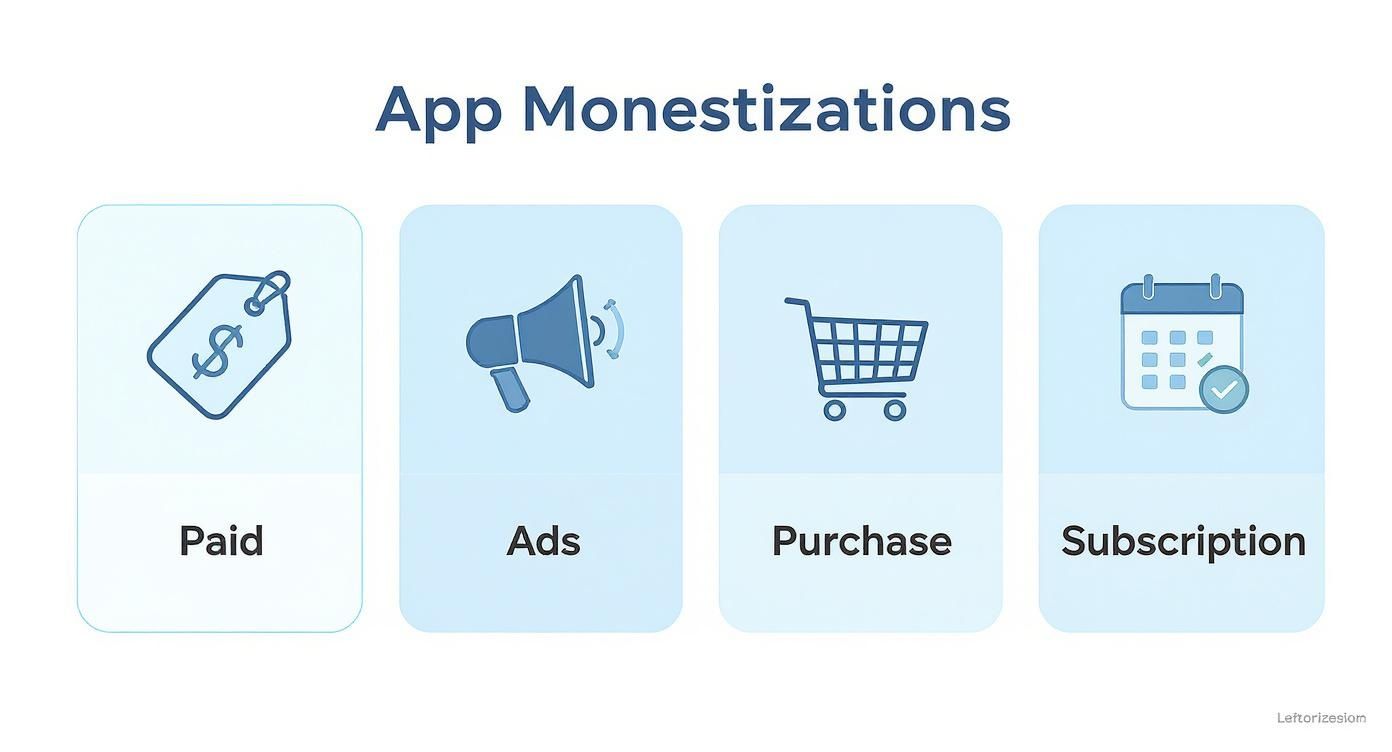
As you can see, each model attracts a different kind of user and generates cash in its own way, which directly shapes a category's overall earning potential.
The Gaming Juggernaut
When you talk about raw revenue, the mobile gaming category isn't just a leader; it's a titan that towers over everything else. From simple puzzle games to sprawling multiplayer worlds, gaming apps have perfected the art of turning screen time into cash, mostly through in-app purchases and rewarded video ads.
The numbers are just staggering. Mobile gaming remains the most lucrative category by a long shot, pulling in an estimated $81 billion in 2024. That accounts for a massive 38% of total app revenue. And it's not slowing down—projections show it will blast past $150 billion per year by 2030, claiming more than half of the entire global gaming market. This explosive growth cements gaming’s role as the primary economic engine of the app world. You can discover more insights about the mobile app market forecast to get a feel for the sheer scale of this trend.
Example in Action: Royal Match
This puzzle game is the freemium model executed to perfection. It’s free to download and play, but it masterfully nudges players to spend real money on extra moves, power-ups, and other perks, generating hundreds of millions in revenue each year.
Social and Entertainment Powerhouses
Right behind gaming, you'll find the social media and entertainment apps. While most are free to use, their business models are built on two incredibly powerful pillars: advertising and subscriptions. These apps command our attention, and where attention goes, revenue always follows.
- Social Media: Platforms like TikTok and Instagram have become money-making machines by selling highly targeted ad space to brands. Their enormous, engaged user bases make them an advertiser's dream.
- Entertainment & Streaming: Apps like Netflix and Disney+ made the subscription model mainstream. They offer massive content libraries for a recurring monthly fee, creating the kind of predictable, scalable revenue that most businesses can only dream of.
Their success comes from embedding themselves into our daily routines, making them feel indispensable.
Health, Fitness, and Productivity Apps
The Health & Fitness and Productivity categories are almost entirely fueled by the subscription economy. These apps thrive by delivering tangible, ongoing value—helping you build better habits, organize your life, or achieve a specific goal.
Think of apps like Strava, Calm, or Notion. Their strategy is simple: offer a free trial or a limited free version to give users a taste of their core benefits. Once you're hooked on the value they provide, upgrading to a premium subscription to unlock the full suite of features feels like a natural next step. Their revenue is built on trust, results, and a loyal community that sees the recurring fee as a worthwhile investment in themselves.
By understanding these benchmarks, you can position your own app for success. You’re not just building a piece of software; you’re choosing your plot of land in the vast, thriving city of the app economy. Choose wisely, and you’ll find yourself in a neighborhood where success isn’t just possible, but probable.
Exploring the iOS vs. Android Revenue Divide
When you start digging into how much money apps really make, you stumble upon a fascinating split in the market. There are two giants, Apple’s iOS and Google’s Android, and they play by surprisingly different economic rules. Getting a handle on this divide is one of the most important things you can do if you're serious about building a profitable app.
Think of it like comparing two different kinds of shopping districts. The Apple App Store is like a high-end, boutique street. It might not have the most foot traffic in the world, but the shoppers who browse there are ready and willing to spend. On the flip side, the Google Play Store is like a sprawling global marketplace, attracting billions of visitors from every corner of the planet, but individual purchases tend to be smaller.
This isn't just a coincidence. It's a reflection of some deep-seated differences in the demographics and habits of the people using these devices.
Why iOS Users Spend More
It’s been a consistent trend for years: iOS users are simply more willing to open their wallets for apps and digital goods. A lot of this comes down to the premium nature of Apple's hardware. iPhones aren't cheap, which often means the user base has, on average, more disposable income.
That one fact creates a powerful ripple effect across the entire App Store. People are just more accustomed to the idea of paying for quality software, whether that's a one-time purchase or an ongoing subscription. For app developers, this translates directly into a higher Average Revenue Per User (ARPU), which is the lifeblood of a healthy app business.
This economic reality is why you see so many new apps, especially subscription-based ones, launch on iOS first. The path to profitability just feels more straightforward when your audience already has a habit of paying for things.
The numbers don't lie. The Apple App Store is a revenue-generating machine, projected to pull in a staggering $138 billion in 2025. In contrast, the Google Play Store is expected to generate around $80 billion. Even though Android has way more users globally, iOS users spend nearly twice as much—an average of $101 per user compared to just $38 on Android. You can discover more insights about app store statistics to see the full breakdown for yourself.
The Android Advantage: Scale and Reach
While iOS might take the crown for direct revenue, Android’s superpower is its incredible, unmatched global scale. With a dominant market share across the world, particularly in emerging economies, Android gives developers a golden opportunity to reach a truly massive audience.
This massive user base makes the platform a titan for monetization models that thrive on volume, especially in-app advertising. An app with millions of daily active users on Android can generate a very healthy income from ad views alone, even if the amount each person spends is tiny.
So, the choice isn't really about which platform is "better." It's about which one is the right fit for your specific business model.
- iOS-First Strategy: This is the go-to for apps built on subscriptions or premium features. You're targeting users who are ready to pay for a great digital experience.
- Android-First Strategy: Perfect for ad-supported apps or apps aiming for global domination, where the main goal is to get in front of as many eyeballs as possible.
Of course, the most successful apps eventually build for both platforms to get the best of both worlds. But they often fine-tune their money-making strategies for each ecosystem's unique quirks. Understanding these core differences will help you make smarter decisions, whether you're launching your first app or looking to grow an existing one. And if you're already managing an iOS app, tracking your performance is critical. Our guide on using Apple Store Connect will help you make sense of your data.
The Real Drivers of App Profitability
Why do some apps become money-making machines while others quietly fizzle out? It's never luck. The difference between an app that prints money and one that drains it comes down to a few core elements working in perfect sync.
Getting these right is how you transform a cool idea into a genuinely profitable business. Think of it like conducting an orchestra—every section needs to be in tune and on time. If the strings are off-key, it doesn't matter how great the percussion is.
So, let's pull back the curtain on the four pillars that truly dictate how much your app can earn.
Getting Users and Keeping Them Around
First things first: you need people. User Acquisition (UA) is the art and science of getting new users to discover and download your app. It’s the lifeblood of any new venture. Without a steady stream of new faces, even the most brilliant app is just shouting into the void.
But getting them in the door is just the opening act. The real story unfolds with User Retention. Are people coming back tomorrow? Next week? Next month? This is where the magic really happens. An app that can't hold onto its users is like a bucket with a hole in it—you can pour all the marketing dollars you want into the top, but it'll always be empty.
High retention proves you've built something that delivers genuine, ongoing value. And the financial impact is massive.
A mere 5% bump in customer retention can skyrocket profitability by 25% to 95%. Loyal, long-term users are simply more likely to spend money, engage with ads, and become advocates for your brand.
The Make-or-Break Power of User Experience
Once you've got users, their in-app experience is everything. A fantastic User Experience (UX) is the invisible engine that powers engagement and loyalty. When an app just works—when it's intuitive, fast, and even a little bit delightful—people stick around. They explore more. They trust you.
On the flip side, a clunky, confusing, or bug-ridden interface is the fastest way to get uninstalled. It doesn't matter how great your features are if people can't find them or get frustrated trying to use them.
A smooth UX isn't just about looking pretty. It directly feeds your bottom line by boosting retention and making users far more open to your monetization methods.
Your Monetization Masterplan
Finally, you have to get paid. Your monetization strategy is your plan for turning all that hard work into actual revenue. As we've covered, this can be through ads, subscriptions, one-time purchases, or a paid download.
The secret isn't just choosing a model, but weaving it into the app's DNA so it feels natural, not greedy. A great monetization strategy feels like a fair value exchange.
- Subscriptions work when they unlock truly essential, premium features that users can't live without.
- In-App Purchases should enhance the experience or offer a fun shortcut, not create frustrating paywalls.
- Ads need to be placed thoughtfully, so they don’t interrupt the very reason someone is using your app.
The most profitable apps align their monetization model perfectly with user value. When you nail these four pillars—Acquisition, Retention, UX, and Monetization—you kickstart a powerful growth cycle. Each one strengthens the others, building an unshakable foundation for a wildly successful app.
How to Estimate Any App's Potential Revenue
Ever found yourself scrolling through the app store, spotting a trending app, and thinking, "I wonder how much money that thing is actually pulling in?" It's a natural question, and you don't need a crystal ball to find the answer. Learning to estimate an app's revenue is a bit like becoming a digital detective—it's a crucial skill for anyone looking to spot hidden gems, understand the market, or maybe even acquire an app.
Think of it like being a real estate appraiser. An appraiser doesn’t just pull a number out of thin air; they look at the property's size, its location, the condition it's in, and what similar houses in the neighborhood have sold for. You can do the exact same thing in the app world. By piecing together the publicly available clues, you can build a surprisingly accurate picture of an app's financial health.
Analyzing the Public Clues
Your investigation begins with the data points that are right there for everyone to see. No single clue tells the whole story, but when you put them all together, they start to paint a pretty clear picture of an app's momentum and earning power.
Here’s what to look for:
- Download Numbers: Both the App Store and Google Play give you a ballpark figure with download tiers like "1M+ downloads". This is your starting point for understanding the sheer size of the user base.
- User Reviews and Ratings: Don't just look at the star rating. A flood of recent, positive reviews is a huge tell. It signals an active, engaged community, which is almost always a sign of healthy revenue.
- Update Frequency: Developers don't pour resources into dead-end projects. If you see an app getting consistent updates, it's a strong hint that it's a profitable venture worth maintaining and improving.
- Category Benchmarks: Get to know the neighborhood. How do other top-performing apps in the same category make their money? Understanding the standard monetization models for, say, a puzzle game versus a productivity tool helps you infer how your target app is likely earning.
When you combine these factors, you can move beyond a wild guess to an educated one. An app with millions of downloads, thousands of glowing new reviews, and weekly updates is clearly doing something right and bringing in serious cash. For a deeper dive into navigating the store itself, check out our guide to the Google Play Store.
Using Competitive Intelligence Platforms
When you're ready to graduate from educated guesses to data-backed analysis, it's time to bring in the big guns. Competitive intelligence platforms are your secret weapon. Tools like Sensor Tower are built to provide detailed estimates on downloads, revenue, and user engagement metrics that you can't see on the app store page.
They can give you a bird's-eye view of the entire market, showing you the top apps and publishers by revenue.
A dashboard like this instantly cuts through the noise. You can see who's dominating the charts and get a powerful benchmark for what's truly possible.
By blending the public clues you gather yourself with the hard data from analytics platforms, you build a reliable framework for figuring out how much an app is worth. This isn't just a fun thought experiment—it's absolutely essential for smart competitive research, validating your own app ideas, and identifying potential acquisition targets.
Answering the Big Questions on App Revenue
When you're first stepping into the app world, the numbers can feel a bit abstract. Everyone wants to know what's really possible, what the genuine financial picture looks like. Let's cut through the noise and tackle some of the most common—and most important—questions that come up.
How Much Can an App with 10,000 Downloads Really Make?
This is the classic question, and the honest answer is: it varies wildly. An app with 10,000 downloads could be making pocket change or it could be pulling in over $10,000 a month. The magic isn't in the download number; it's in how you turn those downloads into dollars.
Think about it this way. If you have a free app that just runs some basic banner ads, you might only see $50 to $200 from those 10,000 users. But what if you have a compelling subscription? If you convince just 2% of those people to pay $5 a month, you're suddenly looking at $1,000 in recurring revenue. Downloads get people in the door, but your monetization strategy is what pays the bills.
What Percentage of Apps Are Actually Profitable?
Let's be real: the app store is a tough place. It’s crowded and competitive. The truth is, a tiny fraction of apps—often estimated at less than 2%—become the runaway successes you read about in the headlines.
But that's not the whole story. A much more encouraging figure, maybe around 10-20%, generate enough income to support a solo developer or a small, dedicated team. The vast majority, however, will struggle just to break even. This really drives home the point that you need more than a good idea; you need a solid business plan, smart marketing, and an app that people truly find valuable.
Success isn't just about building a great app; it's about building a sustainable business around it. The most profitable apps solve a real problem or provide immense entertainment value that users feel is worth their money or attention.
Can a Free App Make Money Without Ads or In-App Purchases?
You bet. But you have to think differently about what "making money" means. In this scenario, the app isn't the cash register—it's the front door to a much larger business. It’s a marketing tool, a customer loyalty machine.
- E-commerce Giants: Think of brands like Nike or Zara. Their apps are free because they exist to sell you shoes and clothes. The app makes the shopping experience seamless, driving sales of their physical products.
- Financial Services: Your bank's mobile app doesn't charge you to check your balance. Its job is to keep you engaged as a customer and make it easy to use their core banking services.
The app's success here isn't measured in direct revenue, but in how well it strengthens the main business.
How Long Does It Take for an App to Become Profitable?
If you're looking for a get-rich-quick scheme, this isn't it. Profitability in the app world is a marathon, not a sprint, and it's incredibly rare for an app to make money from day one. For most successful apps, the journey to breaking even takes anywhere from six months to two years, and sometimes longer.
First, you have to focus on getting users and making sure your app is rock-solid. You're constantly tweaking, improving, and listening to feedback. Profitability only comes after you've built a solid user base, figured out the best way to monetize, and ensured that what you earn from a customer is more than what you spent to get them. Patience is the name of the game.
Ready to see what's really possible? Instead of guessing, get access to verified revenue data from hundreds of successful app founders. With what's the app, you can explore a live leaderboard of profitable apps, analyze real-world metrics, and discover what’s working right now. Start your competitive research with numbers you can trust.
Article created using Outrank
Related Articles
How to Monetize Mobile Apps for Lasting Revenue
Discover how to monetize mobile apps with proven strategies. Learn from real-world examples to build a profitable and sustainable revenue model for your app.
How Do You Launch an App Built to Sell?
Learn how do you launch an app designed for acquisition. This guide offers proven strategies for building a sellable asset from day one.
What Is the Real Simple App Cost to Buy or Sell an App
Discover the true simple app cost. Our guide reveals the factors that determine app valuation for buyers and sellers, from build costs to revenue potential.

Buying & Selling Mobile Apps: The Definitive Guide for 2024
Thinking about buying mobile apps? Learn how to find, value, and acquire profitable apps with our founder-first guide to due diligence and deal-making.