
How to Monetize Mobile Apps for Lasting Revenue
Turning your app into a genuine business isn't about just flipping a switch—it’s about building a thoughtful, sustainable revenue engine from the ground up. This means weaving your monetization strategy right into the fabric of your user experience, so it feels like a natural part of the journey, not a jarring interruption.
The goal is to match your revenue model to what your users truly want and need.
The Pillars of App Monetization
You've got a few core paths to choose from, and the magic often lies in blending them to create a system that works for your specific audience.
- Advertising: A classic for a reason. You can generate revenue from impressions and clicks, making it a great fit for apps with high traffic where you want to keep the core experience free.
- In-App Purchases (IAPs): Perfect for selling digital goods, whether it's a one-time feature unlock, a pack of in-game currency, or a cosmetic item. It's a direct transaction based on perceived value.
- Subscriptions: This is the holy grail for predictable, recurring revenue. It builds a long-term relationship with your users and often leads to a much higher average revenue per user (ARPU).
- Hybrid Models: Don't feel boxed in! The most successful apps often mix and match. Think of a game that's free to play with ads but offers IAPs to speed up progress and a premium subscription to remove ads and unlock exclusive content.
Why You Can't Afford to Wait
Deciding on your monetization model shouldn't be an afterthought. It needs to be part of your app’s DNA from the very beginning, influencing everything from UI design to feature development.
Think about it: a freemium game might strategically place rewarded video ads to help users overcome a tough level, which actually boosts engagement. On the other hand, a productivity app might focus on building immense value to justify tiered subscriptions for its power users.
The numbers don't lie. By 2024, the global app market ballooned to over $935 billion. Drilling down, iOS apps pulled in a staggering $103.4 billion compared to Google Play's $46.7 billion. The spending habits are just as telling: the average iOS user spent $101 ARPU, dwarfing the $38 spent on Android. You can dive deeper into these trends in Tipalti’s excellent app monetization guide.
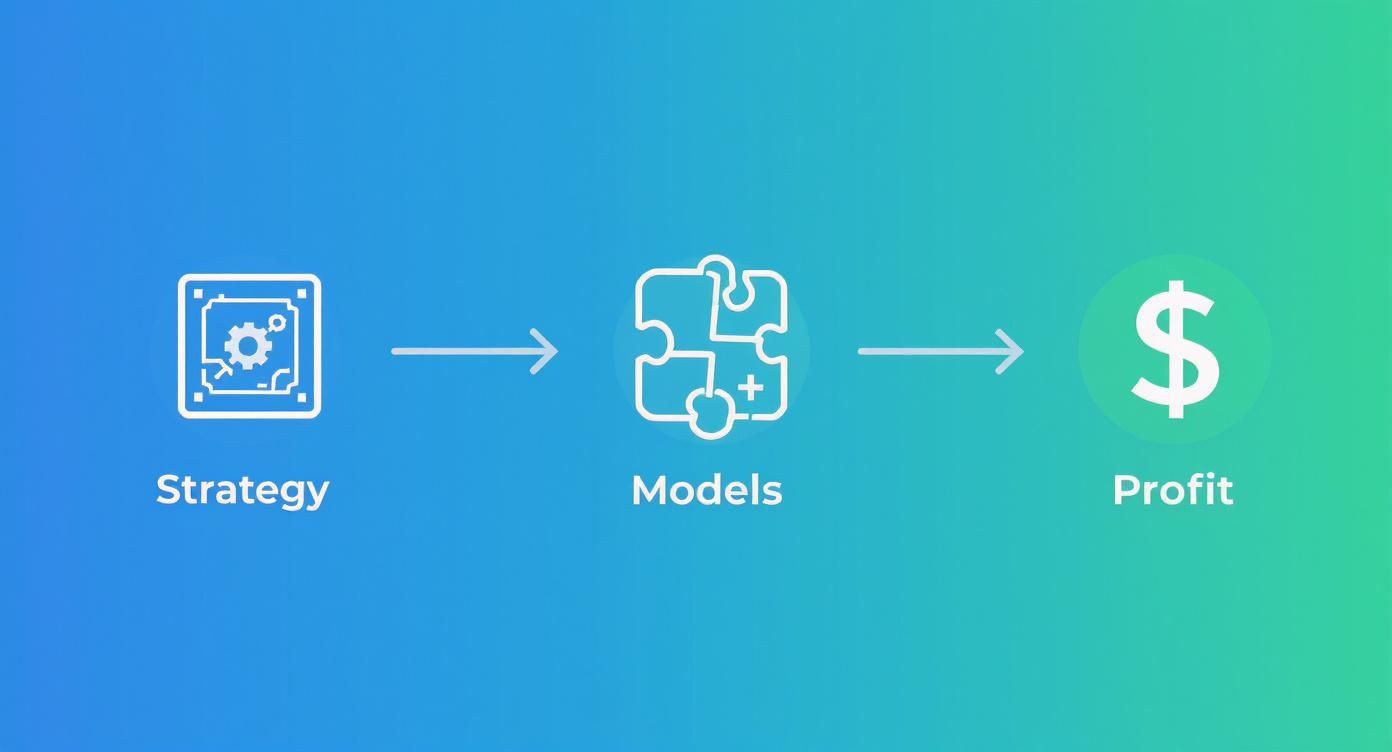
This process isn't just a checklist; it's a cycle. You start with a strategy, choose your models, execute, and then use that data to refine your strategy all over again.
Core Mobile App Monetization Models at a Glance
To help you get a clearer picture, I've put together a quick comparison of the main monetization models. This table breaks down what each model is best for, how it makes money, and its potential impact on your users.
| Monetization Model | Best For | Primary Revenue Driver | User Experience Impact |
|---|---|---|---|
| Advertising | Free or high-traffic apps | Impressions and clicks | Low friction, but watch for ad fatigue. |
| In-App Purchases | Games, consumables, features | One-time buys | Can feel gated if value isn't clear. |
| Subscriptions | SaaS, media, wellness, services | Recurring fees | Encourages deep, ongoing engagement. |
Ultimately, this table is a starting point. The real power comes from understanding your specific app and audience to choose the right fit—or the right combination.
“Blending multiple models lets apps pivot as user behavior evolves.”
Building Your Pricing Framework
Okay, you've chosen a model. Now, how much do you charge?
Don’t just pluck a number out of thin air. Your pricing needs a solid foundation. Start by mapping out your user journeys and benchmarking against your competitors. Then, the real work begins: experimentation.
You need to constantly test different price points, trial lengths, and feature bundles to see what resonates. This isn't a one-and-done task; it's a continuous process of learning and adapting.
- Lean on powerful analytics tools like RevenueCat or Adapty to get deep insights into your subscription health.
- Keep a close eye on your key metrics, especially ARPU (Average Revenue Per User) and LTV (Lifetime Value), to gauge performance.
- Make it a habit to iterate on your paywall design and pricing every single month. Small tweaks can lead to big wins.
Your Path Forward
So, what's next? Start by taking an honest look at your current monetization mix. Where are the opportunities? What experiments can you prioritize right now?
Most importantly, talk to your users. Send out surveys, run interviews, and get direct feedback on what they find valuable and what they'd be willing to pay for.
Build a roadmap that balances short-term revenue goals with the long-term health of your user community. Schedule a recurring monthly meeting with your team to review the data, discuss what you’ve learned, and refine your strategy.
With a clear blueprint in hand, you'll be able to move quickly when your metrics tell you something is off or when a new trend emerges. For the technical side of things, our guide on setting up billing with Apple Store Connect will walk you through integrating payments seamlessly.
By treating monetization as an ongoing, data-driven process, you can transform your app from a passion project into a thriving, sustainable business. Now go make it happen.
Choosing Your Core Monetization Strategy

This is it. This is the moment your app’s financial journey truly begins. Picking the right monetization model isn’t just a line item in a business plan; it’s a core product decision that will shape your entire user experience. Forget the abstract theories—we're going to dive into a practical framework for making this critical choice.
Your monetization strategy should feel like a natural extension of your app's value, not a clunky tollbooth you’ve awkwardly placed in front of your users. It all comes down to deeply understanding who your users are, what problems you're solving for them, and what they’re genuinely willing to pay for. This decision defines how you'll grow, how you'll scale, and ultimately, whether you can build a sustainable business.
Unpacking the Big Three Monetization Models
Most successful app monetization strategies boil down to three primary models: In-App Advertising (IAA), In-App Purchases (IAP), and Subscriptions. Each one serves a different purpose and is a better fit for different kinds of apps.
In-App Advertising (IAA)
This model is the undisputed workhorse for apps with a massive, highly engaged user base that might not be willing to pay directly. Think hyper-casual games, news aggregators, or social platforms where the core experience is meant to be free.
Revenue comes from impressions or clicks on ads shown inside the app. The real art here is integrating ads so they don't completely derail the user's flow. Rewarded video ads are a brilliant example of this done right. A player in a mobile game might happily watch a 30-second ad to get an extra life or a power-up. It's a classic win-win.
Advertising has become the dominant force in app monetization for a reason. Projections show that by 2025, advertising will account for a staggering $381 billion of app market revenues. As of March 2024, a full one-third of global app publishers have integrated ads, making it the most common practice out there. You can get more insights on mobile ad revenue trends from Adnimation.com.
Key Takeaway: Advertising is fantastic for monetizing large audiences with low friction. Your main challenge will always be balancing ad revenue with user experience to keep people coming back.
In-App Purchases (IAP)
IAPs let users buy digital goods or unlock specific features with a one-time payment. This model is incredibly effective for gaming apps (think selling in-game currency or cool cosmetic items) and utility apps that offer permanent feature upgrades.
For instance, a photo editing app could offer a solid set of filters for free but sell advanced "Pro" filter packs for a few dollars each. This is great because it lets users pay only for the specific value they want, creating a direct line between utility and revenue.
Subscriptions
Subscriptions create a recurring revenue stream by offering ongoing access to content or premium features for a monthly or annual fee. This model is the gold standard for predictable, stable income and is perfect for apps that provide continuous value. We see it everywhere with streaming services (Netflix), wellness apps (Calm), and productivity tools (Todoist).
You can get creative with tiered subscription plans to appeal to different types of users. A meditation app, for example, could have:
- A free tier with basic meditations.
- A $9.99/month plan with its full content library.
- A family plan for $14.99/month.
The Power of the Hybrid Approach
Here's a pro-tip: you don't have to marry just one model. In fact, some of the most sophisticated and successful monetization strategies are hybrids, blending different approaches to appeal to a wider range of user preferences.
Combining models unlocks new revenue streams simply by giving users choices. A user who would never dream of subscribing might be perfectly happy to watch a rewarded ad now and then. Meanwhile, a power user will gladly pay a monthly fee to get rid of all ads and unlock exclusive features.
Here are a few powerful hybrid combinations I've seen work well:
- Freemium + Ads + Subscription: A news app can be free with banner ads, but offer a subscription to remove them and access premium, in-depth articles. This is the playbook for many major publications.
- IAP + Subscription: A creative tool like Procreate could sell individual brush packs (IAP) while also offering a cloud storage subscription for syncing projects across devices.
- Ads + IAP: A mobile game can be entirely free-to-play and supported by ads, but also let players make in-app purchases to speed up their progress or buy special items.
How to Find Your Perfect Match
Choosing your strategy isn't about chasing the latest trend; it's about aligning your model with your app's core purpose and your users' behavior. To find your perfect fit, you need to get brutally honest with yourself and look at your app through these two lenses:
- What is your app's core value proposition? Do you provide ongoing, daily value (a natural fit for subscriptions)? Or do you offer one-time solutions or digital goods (much better suited for IAP)?
- Who is your target audience? Are they casual users who expect everything to be free (making ads a good starting point)? Or are they professionals who will gladly pay for powerful tools that save them time and money (a clear signal for subscriptions)?
By answering these questions, you can build a monetization strategy that doesn’t just make money but actually enhances the value you provide. If you're looking for inspiration or want to see how other successful apps are valued in the real world, exploring a marketplace of apps for sale can be an incredibly eye-opening exercise.
Bringing Your Monetization Tech to Life

Alright, you’ve got your strategy sketched out. Now for the exciting part: building the engine that actually makes you money. This isn't just about dropping in a few lines of code; it's about picking the right partners and tools that will do the heavy lifting for you. A solid tech stack transforms your monetization plan from a blueprint into a real, revenue-generating machine.
This is where the rubber meets the road. Integrating powerful SDKs for ads and subscriptions is what connects your app to the marketplace. Let’s pull back the curtain on this process and look at the essential tools that will make your strategy sing.
Get the Most from Every Ad with Mediation
If ads are in your playbook, don't just plug in a single ad network and call it a day. That’s a rookie mistake. To really squeeze every last drop of value out of your ad space, you absolutely need an ad mediation platform. Think of it as a super-smart auctioneer working for you 24/7.
Instead of being stuck with one network's pricing, a platform like Google AdMob or AppLovin MAX broadcasts your ad request to multiple networks at once. They all bid in real-time for that single impression, and the highest bidder wins. Simple as that. You get the best possible price (eCPM) for every ad you show.
This isn't just about more money—it’s about smarter work. The whole process is automated, which diversifies your income and saves you from a world of complexity.
- Google AdMob: A brilliant place to start. It gives you access to Google’s enormous ad inventory and is known for being incredibly user-friendly.
- AppLovin MAX: A true powerhouse for its advanced bidding technology and deep analytics, helping you fine-tune your ad performance like a pro.
Adopting a mediation partner is a force multiplier. It creates a competitive marketplace for your ad space, directly boosting your ARPU without you having to manually juggle a dozen different SDKs.
Make Subscriptions and Purchases Painless
For those of us using subscriptions or in-app purchases, managing the backend across both the App Store and Google Play can feel like a circus act. Each store has its own rules, receipt formats, and backend quirks. This is precisely why a subscription management platform is your new best friend.
Tools like RevenueCat and Adapty are lifesavers. They sit between your app and the app stores, handling all the messy, cross-platform details of purchases, renewals, and subscription states. You integrate one clean SDK, and they take care of the rest, saving your engineers from building and maintaining a fragile, custom payment system from scratch.
But they do so much more than just handle transactions. These platforms give you a single, unified dashboard with the metrics that matter: cohort analysis, churn rates, and revenue trends. You get one source of truth for your app's financial health, which is pure gold for making smart decisions.
Don't Fall into These Common Integration Traps
Integrating these SDKs is usually pretty smooth, but I've seen a few common missteps cause some serious headaches.
First, read the documentation. I know, I know—it sounds obvious. But you’d be surprised how many developers jump straight into the code and run into problems that a quick ten-minute read could have prevented.
Next, test everything relentlessly in a sandbox environment before you even think about going live. I’m talking about new purchases, trial conversions, cancellations, renewals—the whole nine yards. A broken payment flow is one of the fastest ways to shatter user trust and kill your revenue.
Finally, set up your server-to-server notifications (often called webhooks). This is non-negotiable. It ensures your backend always knows a user's real-time subscription status, even if they manage it outside your app. For a great walkthrough on the nitty-gritty, check out our documentation on the Google Play Store. Getting this right is crucial for keeping your data accurate and your users happy.
Mastering Pricing and Paywall Experiments
Let's be clear: pricing isn't a one-and-done task you check off a list. It's a living, breathing conversation you're constantly having with your users. The numbers you attach to your subscriptions or in-app purchases are more than just revenue drivers—they’re a direct signal of the value you believe your app delivers.
Getting this right is what separates the apps that just get by from the ones that build a truly sustainable growth engine.
Your mission is to foster a culture of constant experimentation. This isn't about blind guesswork or just copying what your competitors are doing. It's about using real data to discover what your users are willing to pay, finding that sweet spot that maximizes revenue without ever making your community feel like they're being taken for a ride.
Adopt a Value-Based Mindset
Before you even think about testing a price point, you need to make a critical mental shift: move from cost-plus pricing to value-based pricing.
Stop asking, "What does it cost me to run this app?" Start asking, "What is the transformation or outcome actually worth to my user?" This single question is the bedrock of any powerful monetization strategy.
A meditation app isn't just selling audio files; it’s selling peace of mind, better sleep, and a calmer day. A productivity tool isn’t just selling a to-do list; it’s selling reclaimed hours and career momentum. When you frame everything around the incredible value you provide, you can anchor your prices higher and with far more confidence.
This mindset directly influences how you design your paywall. Don't just list features—tell a story. Communicate the tangible benefits and the "after" state a user will achieve once they upgrade.
- Before: "Unlock 50+ templates."
- After: "Create stunning presentations in minutes with our exclusive Pro templates."
See the difference? One is a feature list; the other is a promise.
Designing Your First Paywall A/B Test
The paywall is the final, pivotal moment in the user’s journey to becoming a customer. Even a tiny improvement here can have an absolutely massive impact on your bottom line. The good news is your first experiment doesn't have to be some complex, multi-variant beast. It just needs to be measurable.
Kick things off with a simple A/B test focused on how you present your pricing. Imagine you have a fitness app. You could test:
- Version A (Control): A standard monthly price of $9.99 and an annual price of $59.99.
- Version B (Test): The same prices, but the annual plan is highlighted with a "Most Popular" badge and shows the equivalent monthly cost of $4.99, emphasizing the 50% savings.
You haven't actually changed the price. You've changed the perception of value. Simple psychological nudges like social proof ("Most Popular") and anchoring (showcasing the savings) are incredibly effective conversion drivers.
Your paywall isn't just a gate; it's your best salesperson. Treat its design, copy, and structure with the same obsessive care you give your core app features. It must be persuasive, crystal clear, and laser-focused on user benefits.
Expanding Your Experimentation Framework
Once you've run a few tests and have a baseline, you can start getting more sophisticated. It's time to move beyond just presentation and start testing the core components of your offer itself. This is where you can truly unlock explosive revenue growth.
Think about every lever you can pull—trial length, plan features, introductory offers, and more. Each one is a fresh opportunity for an experiment that teaches you something new and invaluable about your users. Your goal is to build a roadmap of tests that systematically lifts your key metrics over time.
To get your gears turning, here are some actionable ideas you can start with.
A/B Testing Ideas for Monetization Optimization
| Monetization Model | Metric to Improve | A/B Test Idea 1 | A/B Test Idea 2 |
|---|---|---|---|
| IAPs | Conversion Rate | Offer a "starter pack" bundle at a slight discount. | Test different price points for your most popular consumable item. |
| Subscriptions | Trial-to-Paid Rate | Vary the free trial length (e.g., 3 days vs. 7 days). | Add an annual plan with a significant discount and highlight it. |
| Ads | ARPDAU | Change the frequency of interstitial ads. | Test a rewarded ad placement that offers a valuable in-app item. |
This is just a jumping-off point. The real magic happens when you form a clear hypothesis, run a clean test on a specific user segment, and then dive into the data to figure out your next move. Tools like RevenueCat or Adapty are indispensable here, as their built-in A/B testing frameworks make running these experiments so much easier.
And remember, every test—even one that "fails"—gives you precious data. An experiment that doesn't lift revenue might reveal that your users are extremely price-sensitive, which is mission-critical information for your next feature launch. Embrace this cycle of learning, and you’ll build a monetization machine that only gets smarter and stronger over time.
Tracking KPIs and Iterating for Growth
https://www.youtube.com/embed/2YUh0gjverA
Getting your monetization strategy live is a huge win, but it’s really just the starting line. The true art of building a profitable app isn’t a one-time setup; it’s a relentless cycle of measuring what’s working, learning from what isn’t, and constantly refining your approach.
You simply can’t improve what you don’t measure. This is where we stop guessing and start making data-driven decisions that will steer your app toward real, sustainable success.
The Metrics That Actually Matter
Forget the vanity metrics. Download counts are great for the ego, but they don't pay the bills. If you want to master mobile app monetization, you need to live and breathe a few core Key Performance Indicators (KPIs). These are the numbers that tell the real story of your app's financial health.
Let's cut through the noise and focus on the essentials you should be tracking from day one.
Average Revenue Per User (ARPU): This is your bottom line—total revenue divided by your active users in a given period. ARPU gives you a clean, immediate signal of how much each user is worth and shows the direct impact of pricing tweaks or new ad placements.
Lifetime Value (LTV): This is the holy grail of app metrics. LTV forecasts the total revenue you can expect from a single user over their entire time with your app. Knowing your LTV is a superpower; it informs every critical decision, from your marketing budget to your product roadmap.
Churn Rate: This is the percentage of users who cancel their subscription or simply stop using your app. High churn is the silent killer of growth. Keeping this number low is the key to building a predictable, recurring revenue stream.
Your goal is simple: create a tight feedback loop where these KPIs guide every single move you make. When a number shifts, you need to know why—and act on that insight immediately.
From Data to Decisive Action
Having the numbers is one thing; using them to make brilliant moves is something else entirely. Your KPIs aren't just a report card; they're your strategic compass.
Imagine you're running a subscription fitness app and you discover your LTV is $50. That one number is a game-changer. It means you can confidently spend up to $49.99 to acquire a new customer and still come out profitable. Suddenly, your marketing team isn't flying blind—they have a clear target for scaling up user acquisition.
On the flip side, what if your monthly churn rate suddenly jumps from 3% to 6%? That’s a five-alarm fire. It’s time to dig in. Did a recent update introduce a nasty bug? Did a competitor just launch a killer new feature? This data is your cue to send out user surveys, analyze session recordings, and find the root of the problem before it eats away at your revenue.
Building Your Monetization Dashboard
To make this all work, you need a single source of truth—no more pulling numbers from five different spreadsheets. This is where tools like RevenueCat or Adapty become invaluable. They consolidate all your subscription data into clean, actionable dashboards.
At a minimum, your command center should show you:
- Monthly Recurring Revenue (MRR): The lifeblood of any subscription business.
- Churn Rate (by cohort): Are new users sticking around as long as your early adopters did?
- LTV to CAC Ratio: The ultimate health metric. A solid business should aim for a 3:1 ratio or better.
- Trial Conversion Rate: A direct measure of how well your onboarding and paywall are performing.
Watching these numbers in near real-time lets you spot trends as they’re happening, not weeks after it’s too late.
Real-World Iteration in Action
Let's make this tangible. You run a language-learning app with a freemium model. After digging into your analytics, you find a golden nugget: users who complete the first five lessons within their first three days have an LTV that is 3x higher than everyone else.
Bingo. Your next move is crystal clear.
You can now iterate on your entire onboarding flow to gently nudge every new user toward that "aha!" moment. Maybe you add some encouraging push notifications, offer a small in-app reward for finishing lesson five, or simplify the UI to remove any friction. You launch the change as an A/B test and watch the KPIs. If the LTV of the new cohort starts climbing, you’ve found a winner.
It’s also crucial to ground your expectations in reality, especially with ad-based models. A typical app with 100,000 monthly active users can generate anywhere from $5,000 to $100,000 in monthly ad revenue in 2025. As you can see in these insights on potential app ad revenue on MonetizeMore.com, that wide range depends heavily on your app's category and user geography, with finance and gaming apps usually commanding higher rates.
This is the rhythm of growth: measure, hypothesize, test, and repeat. When you let the data lead, monetization stops being a static feature and becomes a dynamic engine for growth.
Burning Questions About App Monetization
Let's be honest, figuring out how to make money from your app can be nerve-wracking. It’s a road paved with big decisions, and it’s easy to feel like you’re flying blind. But asking these tough questions is a sign you're on the right track—thinking like a business owner, not just a developer.
This is your space to get some straight answers. We're cutting through the noise to tackle the most common questions and fears that pop up when it's time to turn your app into a real business. These aren't just theories; they're hard-won lessons from the trenches.
When Should I Actually Start Monetizing My App?
This is the big one, and the answer is almost never "on day one." Trying to monetize before you have a dedicated user base is like opening a store with no products on the shelves. Your first, and most important, job is to win over users and keep them coming back. Retention is everything.
You need to prove that your app solves a real problem or provides genuine joy—enough that people can't imagine not using it. Once you have a core group of fans who are consistently engaging with your app, that's your signal. This usually means hitting a meaningful milestone for Daily Active Users (DAU) or seeing a retention curve that doesn’t just drop off a cliff after day one.
The right time to introduce monetization is after you've delivered undeniable value to a loyal audience. The biggest mistake I see is rushing this. You end up throwing up a clumsy paywall and scaring away your earliest champions before they've even had that "aha!" moment with your product.
For an app focused on content or a specific utility, you might want to wait until you have a few thousand people using it regularly. If you've built a game, you'll want to see clear patterns of people coming back for more sessions. Your data holds the answer—let it tell you when your users are ready for the next step.
How Can I Make Money Without Driving My Users Away?
This is a totally valid fear. Nobody wants to be the developer of that annoying, spammy app. The secret to doing this right boils down to one simple concept: value. Your monetization strategy has to feel like a fair trade, not a shakedown. The idea is to weave it into the experience so it feels helpful, not like a roadblock.
Ask yourself how your revenue model can actually align with what your users are trying to accomplish.
- Rewarded Ads: Instead of a jarring pop-up, what if you offered users a choice? Let them watch a short video ad to get an extra life in a game or unlock a premium feature for an hour. This puts them in the driver's seat.
- The Freemium Model: The free version of your app needs to be great on its own. It should solve the user's main problem and get them hooked. The paid version is then an upgrade for your power users—the ones who need more advanced tools and are happy to pay for them.
- Smart In-App Purchases: IAPs should always enhance the user's experience, not hold it hostage. Think about selling cool cosmetic skins in a game or offering a one-time purchase to unlock a specific pro-level feature in a productivity app.
The goal is to eliminate friction. When a user is presented with a chance to pay, it should feel like an opportunity, not an obstacle.
Seriously, How Much Money Can My App Actually Make?
This is the million-dollar question, and while the answer is a massive "it depends," we can definitely anchor it in reality. Your app's potential earnings are a direct result of your niche, the size of your user base, how engaged they are, and the monetization path you choose.
It's all about the math. A niche finance app with 10,000 dedicated subscribers paying $10/month is a $1.2 million per year business. A casual game trying to make that same amount from ads, on the other hand, would need millions of active users to even get close.
Looking at industry benchmarks can give you a good sanity check. For apps running on ads, a common range in 2024 is somewhere between $5,000 to $100,000 in monthly revenue for an app with 100,000 monthly active users. That's a huge range, I know. It all depends on things like where your users are located (U.S. users are worth more to advertisers) and your app's category (finance apps earn more per ad than simple utility apps).
Don't get hypnotized by the wild success stories you read about online. Focus on your own numbers. Just think—improving your Average Revenue Per User (ARPU) by even $0.10 can make a huge difference when you have thousands of users. Track your metrics, run experiments, and aim for steady, predictable growth.
Ready to see how your app's revenue stacks up against the competition? what's the app provides a verified, transparent database of real app revenues. Benchmark your performance, discover new trends, and make data-driven decisions. Explore the live leaderboards and see what's really possible.
Article created using Outrank
Related Articles
How Much Do Apps Make An Insider's Guide
Curious how much do apps make? Explore real-world revenue models, monetization strategies, and the key factors that drive app store profitability.

How Do You Launch an App Built to Sell?
Learn how do you launch an app designed for acquisition. This guide offers proven strategies for building a sellable asset from day one.

What Is the Real Simple App Cost to Buy or Sell an App
Discover the true simple app cost. Our guide reveals the factors that determine app valuation for buyers and sellers, from build costs to revenue potential.

Buying & Selling Mobile Apps: The Definitive Guide for 2024
Thinking about buying mobile apps? Learn how to find, value, and acquire profitable apps with our founder-first guide to due diligence and deal-making.